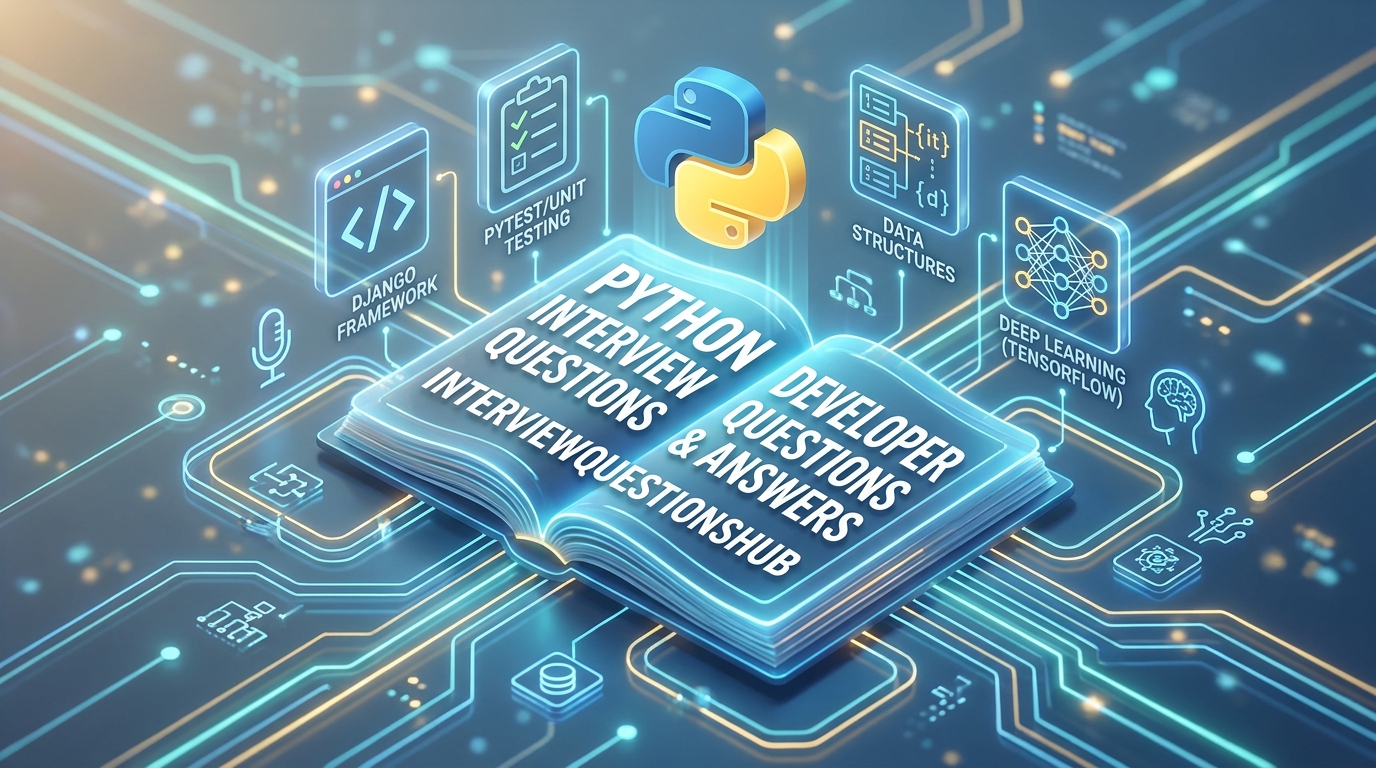
Decoding the Python Interview: From Syntax to Solutions
You’ve just finished a beautiful piece of code, but during the technical round, the lead dev asks, “Why did you use a list instead of a generator here?” Suddenly, your mind goes blank. It’s a classic scenario; the gap between writing code that works and explaining why it’s efficient can feel like a chasm. Whether you’re a fresher trying to land your first “Junior” role or an experienced pro architecting complex data pipelines, the Python interview is about more than just knowing print("Hello World"). It’s about demonstrating your grasp of memory management, concurrency, and clean code principles.
This guide is for those who want to move past memorized definitions and understand the “Senior” perspective. We’ve gathered the most impactful Python Developer interview questions and answers to help you navigate your next career move. You’ll learn to articulate your logic, handle edge cases, and show that you’re not just a coder, but a Pythonic problem solver.
Quick Answer
To ace a Python Developer interview, you must demonstrate a deep understanding of core concepts like decorators, generators, and memory management (GIL). Success depends on writing “Pythonic” code that is readable, efficient, and leverages the right data structures for specific performance needs.
Top 5 Python Developer Interview Questions
- What is the difference between a List and a Tuple in Python?
- How does memory management work in Python (Garbage Collection)?
- What are Python Decorators and how do they work?
- Can you explain the “Global Interpreter Lock” (GIL)?
- What is the difference between Deep Copy and Shallow Copy?
QUICK OVERVIEW TABLE
| Topic | No. of Questions | Difficulty Level | Best For |
| Core Syntax & Data Types | 5 | 🟢 Beginner | Freshers |
| Advanced Logic (OOP/Decorators) | 5 | 🟡 Intermediate | All Levels |
| Web Frameworks (Django/Flask) | 5 | 🟡 Intermediate | Web Developers |
| Memory & Concurrency | 5 | 🔴 Advanced | Senior Developers |
MAIN Q&A SECTION
1. What is the difference between a List and a Tuple?
🟢 Beginner
Here’s the thing: the biggest difference is “mutability.” Lists are mutable, meaning you can add, remove, or change elements after creation. Tuples are immutable; once you define them, they’re set in stone. In my experience, a lot of candidates miss the performance aspect. Because tuples are immutable, Python allocates a fixed block of memory for them, making them slightly faster and more memory-efficient than lists. Honestly, if you have a collection of data that shouldn’t change—like geographic coordinates—use a tuple. It’s safer and more Pythonic.
2. How does memory management work in Python?
🟡 Intermediate
Python handles memory through a private heap space. All objects and data structures live here, and as a developer, you don’t usually touch it directly. Instead, the Python memory manager handles it via “Reference Counting.” Every time an object is referenced, its count goes up; when references drop to zero, it’s deleted. But there’s a catch: “Cyclic References” (where two objects point to each other). To handle these, Python has a built-in Garbage Collector that periodically hunts down these loops and clears them out. This is actually really important for preventing memory leaks in long-running applications.
3. Can you explain Python Decorators?
🟡 Intermediate
Think of a decorator as a “wrapper” for a function. It allows you to modify the behavior of a function or class without permanently changing its source code. You’ll often see them used for logging, access control, or timing how long a function takes to run. Under the hood, a decorator is just a function that takes another function as an argument and returns a new function. A lot of candidates find this confusing, but once you realize that functions in Python are “first-class objects” (meaning they can be passed around like variables), decorators become a very powerful tool in your kit.
4. What is the Global Interpreter Lock (GIL)?
🔴 Advanced
The GIL is a mutex (or a lock) that allows only one thread to execute Python bytecode at a time. This is a bit of a controversial topic. It exists to make memory management easier and thread-safe, but it means that even on a multi-core processor, standard Python threads don’t truly run in parallel for CPU-bound tasks. In my experience, if you’re building something like a high-performance math engine, the GIL can be a bottleneck. To get around it, you’d use the multiprocessing module instead of threading, as it gives each process its own Python interpreter and GIL.
5. What is the difference between a Generator and a List?
🟡 Intermediate
Honestly, this one trips people up when they’re dealing with “Big Data.” A List stores all its elements in memory at once. If you have a list of a billion numbers, your RAM might give up. A Generator, however, yields items one by one only when you ask for them. It uses a concept called “Lazy Evaluation.” You create it using the yield keyword or generator expressions. In my experience, using generators is a lifesaver when processing massive log files or database streams because your memory usage stays low regardless of the dataset size.
6. How do you handle Errors and Exceptions in Python?
🟢 Beginner
In Python, we use try, except, else, and finally blocks. The try block contains the risky code, and except catches the error so your app doesn’t crash. A lot of developers forget the finally block, but it’s actually really important because it runs no matter what—perfect for closing file handles or database connections. Here’s a tip: never use a “bare except” (just except:). Always catch specific errors like ValueError or KeyError. It makes your code much easier to debug because you aren’t accidentally hiding other bugs.
7. What are *args and **kwargs?
🟢 Beginner
These allow you to pass a variable number of arguments to a function. Use *args when you want to pass a non-keyworded, variable-length argument list (it comes through as a tuple). Use **kwargs for keyworded arguments (it comes through as a dictionary). Think of them as “wildcards” for your functions. I often see these used in class inheritance or when building decorators where you don’t know exactly what the user might pass through. It makes your functions incredibly flexible, though you should use them sparingly to keep your code readable.
8. What is the difference between “Shallow Copy” and “Deep Copy”?
🟡 Intermediate
This is a classic “gotcha” question. A Shallow Copy creates a new object, but it fills it with references to the original nested objects. So, if you change a list inside a shallow-copied dictionary, the original dictionary changes too! A Deep Copy, however, creates a completely independent clone of the entire object tree. Changes to the deep copy never affect the original. In my experience, using copy.deepcopy() is safer when you’re working with complex configurations, but keep in mind it’s slower because it has to recursively copy everything.
9. How does “Inheritance” work in Python OOP?
🟡 Intermediate
Python supports single, multiple, and multi-level inheritance. You simply pass the parent class into the child class definition. A key thing to remember is the super() function, which allows you to call methods from the parent class. Python uses something called “Method Resolution Order” (MRO) to decide which method to call when there’s a conflict in multiple inheritance. Honestly, while multiple inheritance is a cool feature, it can make code very messy. I usually suggest sticking to composition or single inheritance unless you have a very specific reason to do otherwise.
10. What are “List Comprehensions”?
🟢 Beginner
List comprehensions provide a concise way to create lists. Instead of writing a four-line for loop to square a bunch of numbers, you can do it in a single, readable line: [x**2 for x in numbers]. They’re faster than manual loops because they’re optimized at the C-level in the Python interpreter. But here’s a senior tip: don’t overdo it. If your list comprehension is so complex that you can’t read it in five seconds, just use a normal loop. Readability always wins over “clever” one-liners.
11. What is the purpose of __init__ and self?
🟢 Beginner
__init__ is the “constructor” of a class. It’s the method that automatically runs when you create a new instance of that class to set up initial values. self represents the instance itself. It’s how the object keeps track of its own data. A lot of freshers find self annoying to type, but it’s how Python distinguishes between local variables and the object’s attributes. Without self, your class wouldn’t know which “name” or “age” belonged to which specific object.
12. How do you manage dependencies in a Python project?
🟡 Intermediate
In my experience, the only way to stay sane is using Virtual Environments (venv or conda). This creates an isolated “bubble” for your project so its dependencies don’t clash with other projects. You’d typically use pip to install packages and keep a requirements.txt file. For more modern setups, I’m seeing a lot of teams move to Poetry or Pipenv because they handle “Dependency Resolution” better and create a lock file to ensure every developer on the team is using the exact same versions of every library.
13. What is the difference between @staticmethod and @classmethod?
🔴 Advanced
A @classmethod takes the class itself as the first argument (usually called cls), meaning it can access or modify class-level state. A @staticmethod doesn’t take any special first argument; it’s basically just a regular function that lives inside a class namespace because it’s logically related to it. I use @classmethods as “Factory Methods” to create class instances in different ways. I use @staticmethods for utility functions that don’t need to know anything about the class’s data.
14. What are “Dunder” (Double Under) methods?
🟡 Intermediate
These are special methods like __str__, __len__, or __add__. They allow you to define how your custom objects behave with built-in Python operators. For example, if you want to be able to “add” two of your objects together using the + sign, you define the __add__ method. This is called “Operator Overloading.” It’s what makes Python feel so seamless—you can make your own classes behave just like built-in integers or strings. It’s a core part of writing clean, “Pythonic” interfaces.
15. What is the difference between is and ==?
🟢 Beginner
== checks for “equality”—do these two things have the same value? is checks for “identity”—are these two things the exact same object in memory? It’s like having two identical $100 bills. == is true because they have the same value, but is is false because they are physically different pieces of paper. This is actually really important when checking for None. You should always use if x is None: rather than if x == None:. It’s faster and is considered the standard way to write it.
COMPARISON TABLE
Python Data Structures: Choosing the Right Tool
| Feature | List | Tuple | Set | Dictionary |
| Mutable? | Yes | No | Yes | Yes |
| Ordered? | Yes | Yes | No | Yes (since 3.7) |
| Duplicates? | Yes | Yes | No | No (Keys) |
| Fastest For | Random Access | Memory Savings | Membership Tests | Key-Value Lookups |
| Example | [1, 2, 2] | (1, 2, 2) | {1, 2} | {"a": 1} |
INTERVIEW TIPS SECTION
- Follow PEP 8: Python has a very specific style guide called PEP 8. Using four spaces for indentation and
snake_casefor variables shows you’re a professional who cares about readability. - Explain the “Why”: Don’t just solve a problem; explain the time and space complexity ($O(n)$ notation). Interviewers want to know if your solution will scale to a million users.
- Write Tests: If you’re doing a coding challenge, write a couple of simple unit tests at the end. It shows you take “Ownership” of your code and care about it not breaking in production.
- Be Framework-Ready: If you’re a web dev, be ready to discuss Django (the “batteries-included” giant) vs. Flask (the lightweight minimalist). Know which one is better for a microservice vs. a large monolith.
- Think Pythonic: Avoid writing C-style loops like
for i in range(len(list)). Usefor item in list:orenumerate()instead. It shows you actually “think” in Python.
WHAT INTERVIEWERS REALLY LOOK FOR
When we interview for Python roles, we’re looking for Readability. Python’s motto is “Readability Counts,” and we want to see code that any other dev can pick up and understand instantly. We also look for Standard Library Knowledge. Python has a massive standard library (the “Batteries Included” philosophy). If you try to build a custom tool for something that itertools or collections already does perfectly, it shows you don’t know the ecosystem well.
Another big factor is Problem Solving. I’ll often give a candidate a problem that is slightly too hard for the time limit just to see how they handle stress. Do you ask clarifying questions? Do you break the problem into smaller pieces? Finally, we look for Practicality. We want devs who choose the simplest, most maintainable solution over the most “clever” one.
FAQ : Python Developer Interview Questions
No. Python 2 reached its end-of-life years ago. Unless you’re maintaining a very old legacy system, you should focus 100% of your energy on Python 3.10 and above.
Not necessarily, but it helps. Since the standard Python interpreter (CPython) is written in C, understanding how C works helps you understand how Python manages memory and why the GIL exists.
Django and Flask are the kings of web development, while FastAPI is rapidly growing for APIs. For data science, NumPy, Pandas, and Scikit-Learn are the industry standards.
For I/O-bound tasks (like scraping websites), use the threading or asyncio modules. For CPU-bound tasks (like processing images), use multiprocessing to bypass the GIL.
Pickling is the process of converting a Python object into a byte stream so it can be saved to a file or sent over a network. “Unpickling” is the reverse process.
CONCLUSION
Python is often called the “second-best language for everything,” and that versatility is exactly why the interviews are so broad. Preparing for Python Developer interview questions is about proving you can write code that is both human-readable and machine-efficient. Focus on the fundamentals—data structures, memory, and OOP—and the rest will follow. Remember, every senior dev has struggled with a NoneType error at some point. Stay curious, keep building, and treat every interview as a chance to learn something new about this incredible language.
Want to dive deeper into specific Python domains? Check out our related guides:
- [Advanced Django Interview Questions for 2026]
- [Data Science with Python: A Beginner’s Guide]
- [Mastering Asynchronous Programming in Python]
You’ve got the logic; now go land the job. Good luck!