The Artisan’s Path: Mastering the Laravel Interview
You’ve just finished building a sleek e-commerce platform using the TALL stack, and you’re feeling like a pro. But then you walk into an interview, and the lead developer asks: “Can you explain how the Service Container resolves dependencies in a circular reference scenario?” Suddenly, your confidence dips. It’s a common pain point; building applications is one thing, but articulating the “magic” happening under Laravel’s hood is another. Whether you’re a fresher trying to land your first “Junior Developer” role or an experienced pro eyeing a Senior Architect position, the Laravel ecosystem is deep and constantly evolving.
This guide is designed to close that gap. We’ve compiled the most critical Laravel interview questions and answers that reflect the real-world challenges of 2026. You’ll learn how to break down complex architectural concepts, defend your coding choices, and prove that you aren’t just using a framework—you’re mastering it.
Quick Answer
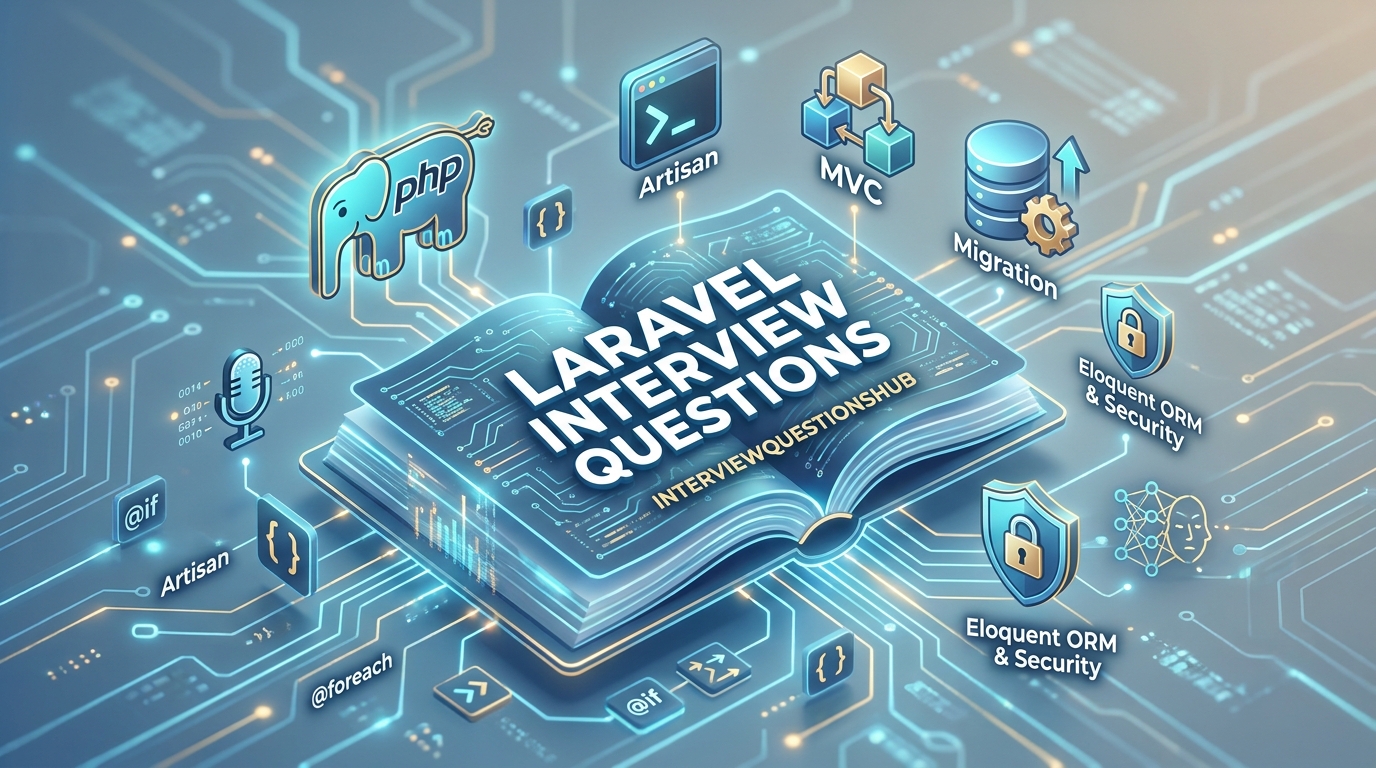
To ace a Laravel interview, you must demonstrate a deep understanding of the MVC architecture, the Eloquent ORM, and the Service Container. Success hinges on your ability to explain how Laravel handles dependency injection, middleware, and database migrations to build scalable, secure PHP applications.
Top 5 Laravel Interview Questions
- What is the Service Container in Laravel?
- How does Eloquent ORM handle relationships between tables?
- What is the difference between
insert()andcreate()in Laravel? - Can you explain the purpose of Middleware with a real-world example?
- How do Service Providers work during the Laravel request lifecycle?
QUICK OVERVIEW TABLE
| Topic | No. of Questions | Difficulty Level | Best For |
| Basics & MVC | 5 | 🟢 Beginner | Freshers |
| Eloquent & Database | 5 | 🟡 Intermediate | All Levels |
| Architecture & Core | 5 | 🔴 Advanced | 3+ Years Exp |
| Security & Performance | 5 | 🟡 Intermediate | Experienced |
MAIN Q&A SECTION
1. What exactly is the Laravel Service Container?
🔴 Advanced
Here’s the thing: the Service Container is the heart of Laravel, but it’s often the hardest part to explain. It’s a powerful tool for managing class dependencies and performing dependency injection. Think of it as a giant map where you tell Laravel, “Whenever I ask for an ‘ImageProcessor’, give me this specific class.” This is actually really important because it allows you to swap out implementations easily. In my experience, if you understand the container, you understand how Laravel stays so flexible and testable. It handles the “new-ing up” of objects so you don’t have to hardcode dependencies everywhere.
2. Can you explain the difference between compact(), with(), and passing an array to a view?
🟢 Beginner
Honestly, this one trips people up because they all do the same thing: send data to the view. compact('user') is just a PHP function that creates an array from existing variables. ->with('user', $user) is a Laravel-specific method that feels a bit more “fluent.” Passing an array like ['user' => $user] is the most explicit way. In my experience, most senior devs prefer compact() because it’s cleaner and less typing. Just make sure the variable name matches the string you pass to compact, or the view will throw an undefined variable error.
3. How do Service Providers fit into the Laravel lifecycle?
🟡 Intermediate
Service Providers are the “glue” that connects your code to the framework. They are the central place for all Laravel application bootstrapping. When the request hits your app, Laravel loops through the providers array in your config and runs the register() and boot() methods. A lot of candidates miss this: you should only bind things to the container in register(). If you need to use a service that is already registered (like a route or an event listener), you do that in boot(). It’s all about the order of operations.
4. What is the difference between Eloquent’s lazy loading and eager loading?
🟡 Intermediate
This is a classic performance-related question. Lazy loading is the default; Laravel only fetches related data when you actually access the property. The problem is the “N+1 query problem.” If you have 20 posts and you loop through them to show the author’s name, lazy loading will run 21 queries. Eager loading uses the with() method to fetch all the data in just 2 queries. Honestly, a lot of candidates miss this during code reviews, but it’s the difference between a fast app and one that crashes under heavy traffic.
5. How does Middleware work in Laravel?
🟢 Beginner
Think of Middleware as a series of layers or “filters” that a request must pass through before hitting your controller. A real-world example is authentication. Before a user can see their dashboard, the auth middleware checks if they’re logged in. If they aren’t, it redirects them to the login page. If they are, it lets the request “pass through” to the next layer. You can also use middleware for CORS, logging, or even maintenance mode. It’s a clean way to keep your controller logic focused on business rules rather than security checks.
6. What is the difference between insert() and create()?
🟡 Intermediate
insert() is a basic Query Builder method that sends data directly to the database; it doesn’t trigger Eloquent features like created_at timestamps or “Events.” create(), however, is an Eloquent method. It automatically handles timestamps and allows for “Mass Assignment” protection. Here’s the catch: for create() to work, you must define the $fillable or $guarded properties in your model. In my experience, candidates who forget to mention mass assignment vulnerabilities when talking about create() show a lack of security awareness.
7. What are “Accessors” and “Mutators” in Eloquent?
🟡 Intermediate
Accessors and mutators allow you to format Eloquent attribute values when you retrieve or set them on model instances. For example, if you store user names in lowercase in the DB but want them capitalized on your site, you’d create a getFirstNameAttribute accessor. Mutators do the opposite—like hashing a password automatically before it hits the database using setPasswordAttribute. This is actually really important for keeping your data consistent without having to manually format strings every time you save or show a record.
8. Can you explain “Method Injection” in Laravel?
🟢 Beginner
Laravel is smart enough to look at the type-hints in your controller methods and automatically provide the objects you need. For example, if you add Request $request to your store method, the Service Container automatically injects the current request instance. You don’t have to worry about how that object is created. This doesn’t just work for Laravel classes; it works for any class you’ve registered in the container. Honestly, this is what makes Laravel feel like “magic” compared to old-school PHP where you had to manually include files and instantiate classes.
9. What is the purpose of the public folder and the storage link?
🟢 Beginner
The public folder is the only directory that should be accessible to the outside world. It contains the index.php file, which is the entry point for all requests. The storage folder, where you might keep user-uploaded photos, is not accessible for security reasons. To show those photos, you run php artisan storage:link, which creates a “symbolic link” from public/storage to storage/app/public. A lot of freshers get confused when their images don’t show up; 99% of the time, they just forgot to run this command.
10. How do you handle database migrations in a team environment?
🟡 Intermediate
Migrations are version control for your database. Instead of sharing SQL dumps, you share migration files. To keep a team in sync, you should never edit a migration file that has already been pushed to the main repo. If you need to change a column, you create a new migration to modify it. In my experience, the biggest mistake teams make is manually changing the database structure in phpMyAdmin. This breaks the “source of truth” and causes “migration mismatch” errors for everyone else. Always use the command line for DB changes.
11. What is the difference between sync(), attach(), and toggle() in relationships?
🔴 Advanced
These are used for Many-to-Many relationships (like Users and Roles). attach() just adds a record to the pivot table, even if it’s already there. sync() is much more powerful; it takes an array of IDs and makes the pivot table match exactly that array, deleting anything else. toggle() is like a light switch—if the ID is there, it removes it; if it isn’t, it adds it. Honestly, I use sync() the most because it prevents duplicate entries and ensures the data is exactly what the user selected in the UI.
12. How do you optimize a Laravel application for high traffic?
🔴 Advanced
Performance tuning is where senior devs shine. First, I use php artisan config:cache and route:cache so Laravel doesn’t have to parse files on every request. Second, I use a fast cache driver like Redis instead of files. Third, I optimize the database with indexes and eager loading. I also look into “Horizon” for managing queues to handle heavy tasks (like sending emails) in the background. In 2026, I’d also mention using Octane with Swoole or RoadRunner to keep the app in memory, which can give you a 5x speed boost.
13. What are “Events” and “Listeners” and why use them?
🟡 Intermediate
Events provide a simple observer implementation, allowing you to subscribe and listen for various actions that occur in your application. For example, when a user registers, you might fire a UserRegistered event. You can then have multiple listeners: one to send a welcome email, another to notify the sales team, and a third to create a default profile. The beauty here is “Decoupling.” Your registration logic doesn’t need to know anything about emails or sales teams. It just fires the event and moves on. It makes your code much cleaner and easier to maintain.
14. What is the difference between Laravel Mix and Laravel Vite?
🟡 Intermediate
Laravel Mix was based on Webpack and was the standard for years. It was great but could be slow to recompile as projects grew. Vite is the new standard. It’s significantly faster because it uses “native ES modules” and doesn’t rebuild the whole bundle every time you save a file. In my experience, switching to Vite saves developers hours of “waiting for refresh” time over a project’s life. If you’re starting a new project in 2026, there’s no reason to use Mix unless you’re maintaining a very old legacy app.
15. How do you prevent SQL Injection in Laravel?
🟢 Beginner
Here’s the thing: Laravel does most of the heavy lifting for you. Both the Eloquent ORM and the Query Builder use “PDO parameter binding” behind the scenes. This means that when you write $user = User::where('email', $request->email)->first();, Laravel automatically escapes the input. However, you can still put yourself at risk if you use “Raw Queries” like DB::select("SELECT * FROM users WHERE id = $id"). In those cases, you should always use the ? placeholder to ensure the data is properly sanitized. Security is a mindset, not just a framework feature.
COMPARISON TABLE
Eloquent vs. Query Builder: Which one to pick?
| Feature | Eloquent ORM | Query Builder |
| Syntax | Very Readable (Active Record) | Close to SQL |
| Performance | Slightly slower (Object overhead) | Very Fast |
| Features | Relationships, Events, Accessors | Basic CRUD and Joins |
| Best For | Complex Logic & Relationships | Bulk Inserts & Simple Reporting |
| Example | User::with('posts')->get() | DB::table('users')->get() |
INTERVIEW TIPS SECTION
- Master the CLI: Be comfortable with
php artisan. If you can’t remember common commands likemake:controllerormigrate:status, it looks unprofessional. - Show off your “Tinker” skills: Mention how you use
php artisan tinkerto test logic quickly without having to refresh the browser. It proves you have a fast workflow. - Know the “PHP 8.x/9.x” Features: Since Laravel is built on PHP, knowing things like Constructor Property Promotion or Attributes shows you understand the foundation.
- Think in “Testing”: Don’t just talk about building features; mention how you would write a Pest or PHPUnit test for it. Laravel makes testing easy, and seniors love candidates who value quality.
- Explain the “Why”: If asked about a design pattern, explain why it helps. Don’t just say “I use repositories.” Say “I use repositories to decouple my Eloquent models from the controller logic for easier testing.”
WHAT INTERVIEWERS REALLY LOOK FOR
When I’m interviewing for Laravel roles, I’m looking for Architectural Maturity. I don’t care if you know every single method name; I care if you know where code should live. Does the logic go in the Controller (bad), the Model (okay), or a Service/Action class (best)? We also look for Database Intuition. A developer who understands indexes and query optimization is worth three developers who just know how to write Model::all().
Another big factor is Security Consciousness. Do you automatically think about CSRF, XSS, and Mass Assignment? Finally, we look for Ecosystem Knowledge. Laravel isn’t just a framework anymore; it’s an ecosystem. Knowing about Laravel Forge, Vapor, Nova, or Pulse shows you’re a serious professional who is invested in the community and its best practices.
FAQ : Laravel Interview Questions
Laravel is a framework built on top of PHP. It provides structure and pre-built tools for common tasks (routing, auth, caching), which makes development faster and more secure than writing everything from scratch in Core PHP.
Always focus on the latest LTS (Long Term Support) version or the most recent stable release. As of 2026, that would be Laravel 11 or higher.
Yes, at least the basics. Modern Laravel uses Vite, Livewire, or Inertia.js, all of which require some level of JS knowledge to build interactive frontends.
It’s a performance issue where an application makes N additional database queries to fetch related data for N records, instead of fetching everything in a single join or eager-loaded query.
Laravel is actually built using many Symfony components! Symfony is generally seen as more “modular” and “strict,” while Laravel focuses on “developer happiness” and expressive syntax.
Yes! While Laravel is great for monoliths, you can use Laravel Lumen (lightweight) or standard Laravel with tools like RabbitMQ for microservice architectures.
CONCLUSION
Laravel is the most popular PHP framework for a reason—it’s powerful, elegant, and fun to use. But preparing for Laravel interview questions requires more than just knowing how to route a URL. It’s about proving you understand the patterns of modern web development and the specific tools Laravel provides to solve them. Don’t get discouraged by the “Service Container” talk; get curious and dive into the source code. When you can explain the “Magic,” you stop being a “Laravel User” and start being a “Laravel Expert.”
Ready to level up your career? Check out our other expert guides:
- [Advanced Eloquent Tips for 2026]
- [Mastering the TALL Stack: A Complete Guide]
- [How to Write a Laravel Developer Resume that Gets Noticed]
The world needs more artisans. Good luck with your interview!