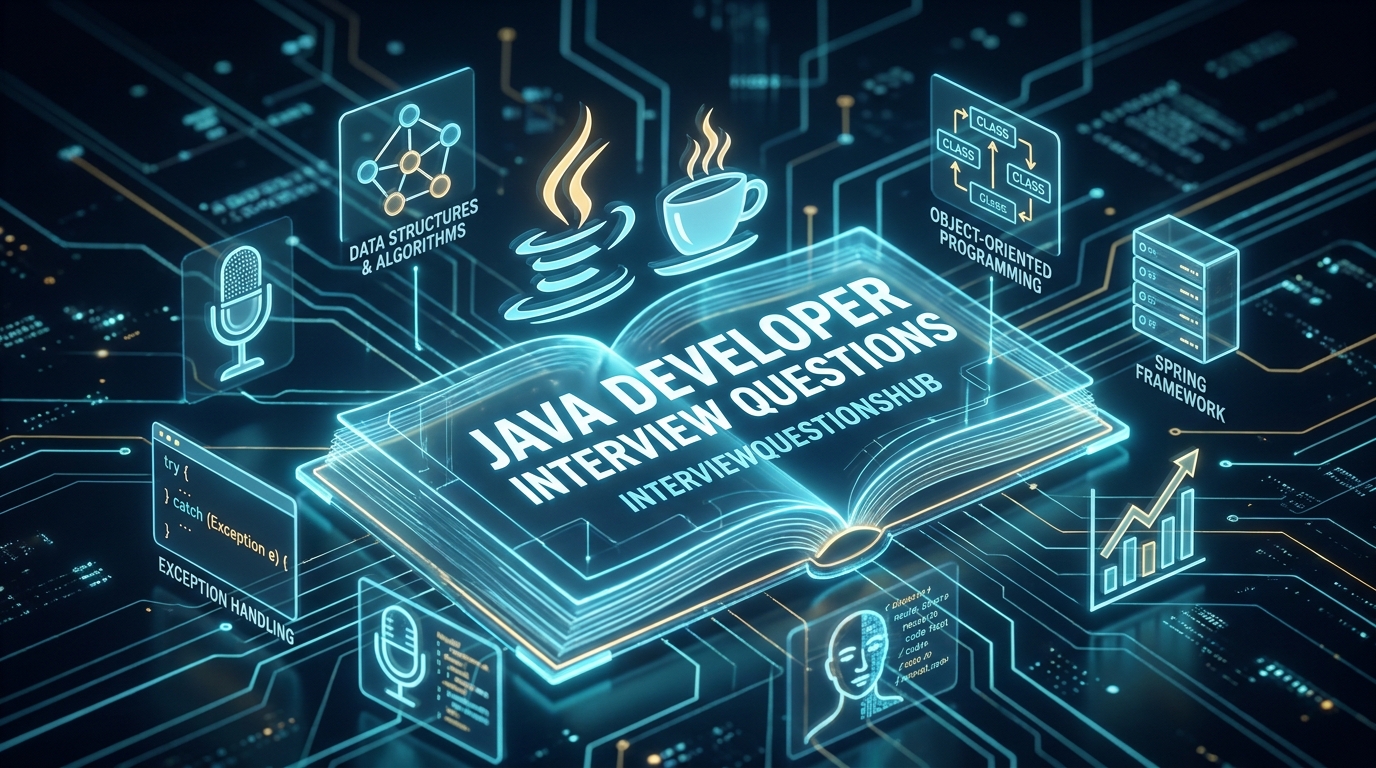
The Java Interview: Beyond Just Syntax and Semantics
Imagine you’re halfway through a technical round, and the interviewer asks you to explain why you’d choose a HashMap over a TreeMap in a high-frequency trading application. You know they both store data, but the “why” is what determines if you get the job. It’s a common pain point; many developers can write code that works, but explaining the architectural “why” under pressure is a different beast. Whether you’re a fresher trying to land your first role at an MNC or an experienced dev eyeing a Senior Architect position, the Java ecosystem is vast and often intimidating.
This guide is built to help you navigate that complexity. We’ve curated the most impactful Java Developer interview questions and answers that cover everything from JVM internals to modern Spring Boot microservices. You’ll learn how to articulate your experience with design patterns, memory management, and concurrency while sounding like the seasoned pro you are.
Quick Answer
To excel in a Java Developer interview, you must demonstrate a deep understanding of Core Java (OOPs, Collections, Exceptions), the Java Memory Model (JVM), and modern frameworks like Spring Boot. Success comes from showing you can write thread-safe, scalable, and maintainable code while following SOLID principles.
Top 5 Java Developer Interview Questions
- What is the difference between
String,StringBuilder, andStringBuffer? - How does the Java Garbage Collection process work?
- What are the new features introduced in Java 17 and Java 21?
- Can you explain the life cycle of a Spring Bean?
- How do you handle thread safety in a multithreaded environment?
QUICK OVERVIEW TABLE
| Topic | No. of Questions | Difficulty Level | Best For |
| Core Java & OOPs | 5 | 🟢 Beginner | Freshers |
| Collections & Streams | 5 | 🟡 Intermediate | All Levels |
| Multithreading & JVM | 5 | 🔴 Advanced | Experienced |
| Spring Boot & Microservices | 5 | 🟡 Intermediate | Experienced |
MAIN Q&A SECTION
1. Why is Java said to be “Platform Independent”?
🟢 Beginner
Here’s the thing: Java isn’t independent because of the code you write, but because of the “Bytecode.” When you compile a .java file, it becomes a .class file containing Bytecode. This Bytecode doesn’t care if you’re on Windows, Linux, or macOS. As long as the machine has a Java Virtual Machine (JVM) installed, it can run that code. In my experience, a lot of candidates forget that the JVM itself is platform-dependent—you need a specific JVM for Windows and a different one for Mac. The “Write Once, Run Anywhere” (WORA) magic only happens because the JVM acts as a universal translator.
2. What is the difference between == and .equals()?
🟢 Beginner
Honestly, this one trips people up in almost every junior interview. Use == when you want to compare “references”—basically, are these two variables pointing to the exact same spot in memory? Use .equals() when you want to compare the “content” or the actual value inside the objects. For example, if you have two different String objects that both say “Hello,” == will return false, but .equals() will return true. This is actually really important when dealing with String pooling and object comparisons in collections.
3. How does a HashMap work internally in Java?
🟡 Intermediate
A HashMap works on the principle of “Hashing.” It uses the hashCode() method to find a bucket location in an underlying array and the equals() method to handle potential collisions. If two different keys end up in the same bucket, Java historically used a LinkedList to chain them. However, since Java 8, if a bucket gets too crowded (more than 8 elements), it transforms that list into a Balanced Tree (Red-Black Tree). This is a huge performance win, improving the worst-case search time from $O(n)$ to $O(\log n)$. Interviewers love it when you mention this Java 8 optimization.
4. Can you explain the “Fail-Fast” vs “Fail-Safe” iterators?
🟡 Intermediate
Imagine you’re looping through a list and another thread tries to add an item at the same time. A Fail-Fast iterator (like the one in ArrayList) will immediately throw a ConcurrentModificationException. It’s like saying, “Stop everything; the data changed!” On the other hand, Fail-Safe iterators (like those in CopyOnWriteArrayList) work on a clone of the collection. They don’t throw exceptions because they aren’t touching the original data while you loop. In my experience, choosing between these depends entirely on whether your application prefers data accuracy or high availability.
5. What is the difference between a Checked and an Unchecked Exception?
🟢 Beginner
Checked exceptions are the ones the compiler “checks” at compile-time. If you’re reading a file (IOException) or connecting to a DB (SQLException), Java forces you to wrap that code in a try-catch block. Unchecked exceptions, also known as RuntimeExceptions (like NullPointerException or ArrayIndexOutOfBoundsException), happen during execution. You aren’t forced to catch them, but you definitely should write code to prevent them. A lot of candidates miss this: Checked exceptions represent conditions outside the control of the program, while Unchecked exceptions usually represent programming flaws.
6. What are the different states of a Thread in Java?
🟡 Intermediate
A thread in Java isn’t just “running” or “stopped.” It goes through a whole lifecycle: New, Runnable, Blocked, Waiting, Timed_Waiting, and Terminated. When you call start(), it goes to Runnable—not necessarily running, but ready for the OS to pick it up. If it’s waiting for a lock, it’s Blocked. If it’s waiting for another thread to finish, it’s Waiting. Honestly, understanding these states is crucial for debugging deadlocks or performance bottlenecks. If your app is slow, checking how many threads are in the “Blocked” state is usually the first place to look.
7. How does Garbage Collection (GC) actually work?
🔴 Advanced
The JVM manages memory automatically using the Heap, which is divided into the Young Generation and the Old Generation. Most objects die young (Minor GC), while long-lived objects get promoted to the Old Generation (Major GC). Modern Java uses sophisticated collectors like G1 (Garbage First) or ZGC. These collectors try to minimize the “Stop-the-World” pauses where the entire application freezes to clean up memory. When you’re explaining this, mention that you can’t force GC; calling System.gc() is just a “hint” to the JVM, and it usually ignores you.
8. What is the “Diamond Problem” in Java and how is it solved?
🟢 Beginner
The Diamond Problem happens in languages that allow multiple inheritance (like C++). If Class A has a method, and both Class B and Class C inherit it and change it, which version does Class D get if it inherits from both B and C? Java avoids this by not allowing a class to extend more than one class. However, we can implement multiple interfaces. If two interfaces have the same “Default Method,” Java forces you to override that method in your class to resolve the ambiguity manually. It’s a clean way to get the benefits of multiple inheritance without the mess.
9. What is the difference between final, finally, and finalize?
🟢 Beginner
This is a classic “fresher” question that even experienced devs sometimes flub. final is a keyword used to make a variable constant, a method un-overrideable, or a class un-extendable. finally is a block used in exception handling that always executes, whether an error happened or not—perfect for closing database connections. finalize is a method that used to be called by the Garbage Collector before destroying an object, but it’s actually deprecated now. In my experience, if you mention that finalize is deprecated, you instantly show you’re up to date with modern Java.
10. Can you explain the concept of “Volatile” keyword?
🔴 Advanced
In a multithreaded environment, each thread might keep a local “cache” of a variable for speed. If Thread A changes a variable, Thread B might still be looking at its old cached version. Marking a variable as volatile tells the JVM: “Don’t cache this! Always read it directly from main memory.” It ensures visibility across threads. However, here’s the catch: volatile does NOT make an operation “atomic.” For example, count++ isn’t thread-safe even if count is volatile. For that, you’d need AtomicInteger or synchronization.
11. What is the purpose of the Optional class in Java 8?
🟡 Intermediate
Optional was introduced to help us move away from the “Billion Dollar Mistake”—the NullPointerException. Instead of returning a null, a method can return an Optional<User>. It’s a container that says, “I might have a user, or I might be empty.” It forces the calling code to acknowledge the possibility of a missing value. Using methods like .ifPresent() or .orElse() makes your code much more readable and “defensive.” Honestly, since I started using Optional, my production crash logs have looked a lot cleaner.
12. What are “Functional Interfaces” and Lambda Expressions?
🟡 Intermediate
A Functional Interface is an interface with exactly one abstract method (like Runnable or Callable). Lambda expressions allow us to treat functionality as a method argument, or code as data. Instead of writing a whole “Anonymous Inner Class” just to sort a list, you can do it in one line with a Lambda. This is the foundation of the Stream API. In my experience, the shift to a more functional style in Java has made data processing much more concise, though it can be a bit harder to debug for people used to traditional loops.
13. How does the “Spring Bean” lifecycle work?
🟡 Intermediate
If you’re applying for a Java role, you likely need to know Spring. A Bean isn’t just an object; it’s managed by the Spring IoC Container. The lifecycle includes: Instantiation, Populating Properties, BeanNameAware, BeanFactoryAware, Pre-Initialization (BeanPostProcessor), AfterPropertiesSet, Custom Init, and finally, Destruction. This sounds like a lot, but usually, you only care about @PostConstruct and @PreDestroy. Understanding this flow is vital when you’re trying to set up resource connections or perform cleanups when the server shuts down.
14. What is the difference between ParallelStream and a regular Stream?
🔴 Advanced
A regular Stream executes sequentially on a single thread. A ParallelStream splits the data into multiple chunks and processes them across multiple CPU cores using the common ForkJoinPool. It sounds like a magic “make it faster” button, but it’s not. For small datasets or tasks that involve blocking I/O, a ParallelStream can actually be slower because of the overhead of splitting and merging the data. I always tell my team: Benchmark it first. Don’t go parallel unless the computation is heavy enough to justify the overhead.
15. What are the SOLID principles in Java?
🟡 Intermediate
SOLID is the blueprint for clean code:
- Single Responsibility: One class, one job.
- Open/Closed: Open for extension, closed for modification.
- Liskov Substitution: Subtypes must be substitutable for base types.
- Interface Segregation: Don’t force a class to implement methods it doesn’t need.
- Dependency Inversion: Depend on abstractions, not concretions.Following these ensures that when a client asks for a new feature, you don’t have to rewrite half the application. This is actually really important for long-term project health.
COMPARISON TABLE
Abstract Class vs. Interface: Which one to pick?
| Feature | Abstract Class | Interface (Java 8+) |
| Inheritance | A class can extend only one. | A class can implement many. |
| Variables | Can have final, non-final, static, and non-static. | Only constants (public static final). |
| Methods | Can have abstract and concrete methods. | Can have abstract, default, and static methods. |
| Access Modifiers | Can be private, protected, or public. | Always public by default. |
| Usage | For “is-a” relationships (Animal -> Dog). | For “can-do” relationships (Can Fly). |
INTERVIEW TIPS SECTION
- Explain your thought process: Don’t just give the answer. Talk through how you arrived at it. Interviewers value “Engineering Intuition” over memorized definitions.
- Code for Readability: If you’re asked to code on a whiteboard, focus on clean variable names and proper structure. A working but messy code is often viewed worse than a slightly buggy but clean one.
- Know your JVM Tools: Mentioning tools like JConsole, VisualVM, or JProfiler shows you know how to handle real-world performance issues, not just write logic.
- Master the “STAR” Method: For behavioral questions (e.g., “Tell me about a bug you fixed”), describe the Situation, Task, Action you took, and the Result.
- Stay Updated: Java moves fast now with a 6-month release cycle. Knowing the difference between Java 8, 11, 17, and 21 shows you’re a professional who keeps learning.
WHAT INTERVIEWERS REALLY LOOK FOR
In a Java interview, the “insider” secret is that we’re looking for Memory Awareness. Java is famous for its Garbage Collector, but a bad dev can still cause memory leaks by hanging onto object references. If you mention “Heap Dumps” or “Memory Analysis,” you’re already in the top 10% of candidates. We also look for Concurrency Comfort. Writing code that works in a single thread is easy; writing code that doesn’t crash when 1,000 users hit it at once is where the skill lies.
Finally, we look for Pragmatism. If you suggest a Microservices architecture for a tiny “To-Do” app, it’s a red flag. We want developers who choose the right tool for the job, even if it’s the “boring” one. We want to know that you understand technical debt and that you write code for the developer who will have to maintain it two years from now.
FAQ : Java Developer Interview Questions
Focus on Java 8 (the foundation of modern Java) and Java 17 (the current most common LTS version). Knowing Java 21 features like Virtual Threads will give you a big advantage.
Absolutely. Java powers the back-end of almost every major bank, insurance company, and e-commerce giant (like Amazon and eBay). It’s not going anywhere.
For most enterprise Java roles, yes. Spring Boot has become the industry standard for building Java-based web applications and microservices.
Practice Core Java logic on LeetCode or HackerRank, but also build a full-stack project using Spring Boot and a database to understand the “Big Picture.”
Be honest. Whether it was for personal reasons or upskilling, show what you learned during that time. A gap doesn’t matter as much as your current skill set.
CONCLUSION
Java is a deep, powerful language, and a successful interview is about showing you’ve mastered both its beauty and its quirks. Don’t just memorize the difference between a List and a Set; understand why you’d pick one over the other when memory is tight. This guide has given you the foundation, but the best way to prepare is to get your hands dirty. Build something, break it, and then figure out why it broke. That “aha!” moment is what actually wins the interview.
Looking to dive deeper into specific Java domains? Check out these related posts:
- [Advanced Spring Boot Interview Questions for 2026]
- [Microservices Architecture: A Java Developer’s Guide]
- [Mastering Java Streams and Lambdas]
You’ve got the knowledge—now go show them why you’re the right person for the job. Good luck!