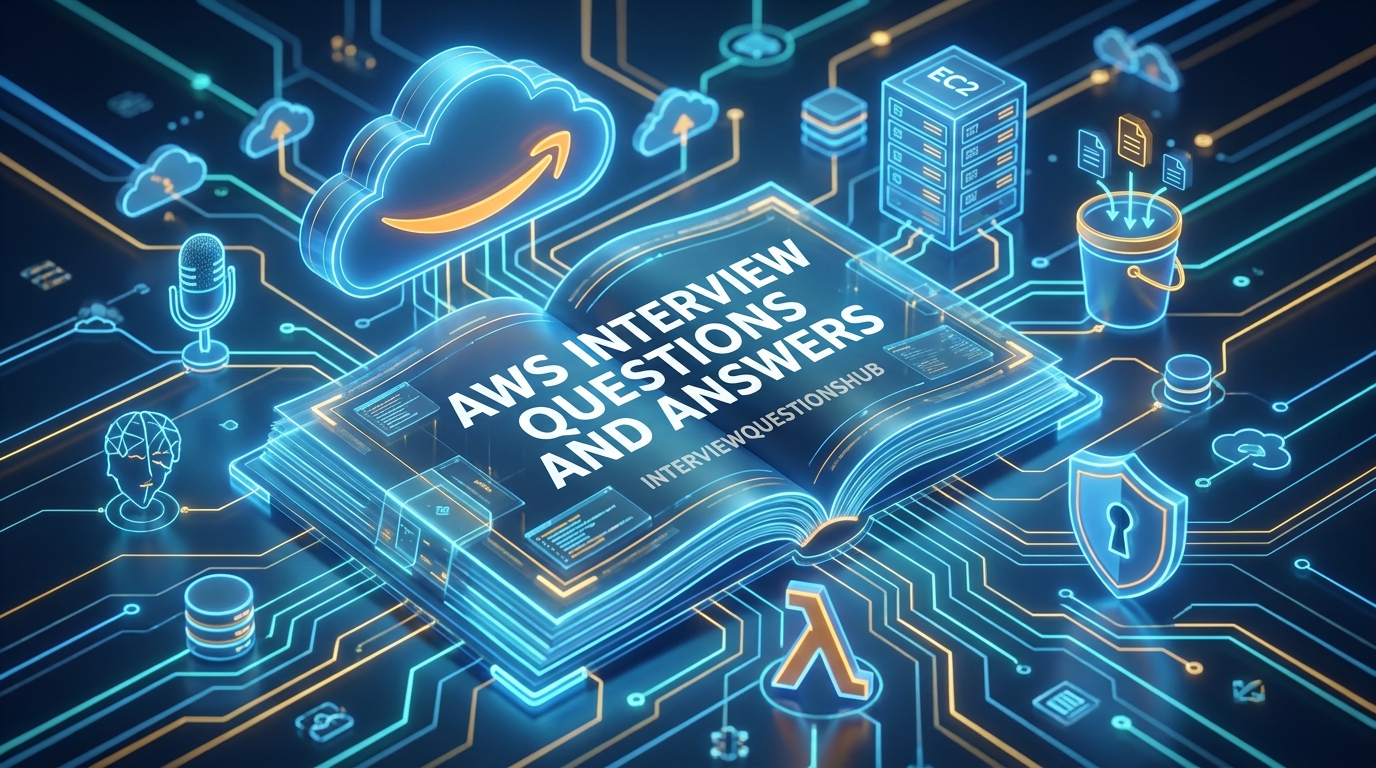
Navigating the Cloud: Cracking the AWS Interview
Imagine it’s the middle of a massive Black Friday sale. Your company’s traffic spikes by 10,000%, and suddenly, the primary database starts lagging. The CTO looks at you and asks, “How do we scale our infrastructure in the next five minutes without losing data or breaking the bank?” This isn’t just a hypothetical; it’s the kind of high-stakes scenario Amazon Web Services (AWS) was built to solve. Whether you’re a fresher trying to understand the difference between an S3 bucket and an EC2 instance, or an experienced architect designing multi-region failovers, the interview is where you prove you can handle the “Cloud.”
This guide is for those who want to sound like a seasoned professional, not a textbook. We’ve gathered the most impactful AWS interview questions and answers that reflect the real-world architecture challenges of 2026. You’ll learn how to articulate your logic, defend your service choices, and prove that you aren’t just a “console clicker,” but a true cloud engineer.
Quick Answer
To excel in an AWS interview, you must demonstrate a deep understanding of the Well-Architected Framework, security through IAM, and the trade-offs between various compute and storage services. Success hinges on your ability to explain how to build scalable, highly available, and cost-optimized systems using the AWS ecosystem.
Top 5 AWS Interview Questions
- What is the difference between a Public Subnet and a Private Subnet?
- How do you choose between S3, EBS, and EFS for storage?
- Can you explain the “Shared Responsibility Model” in AWS?
- What is the difference between Scalability and Elasticity?
- How do you handle a “Stateful” application in a “Stateless” Cloud environment?
QUICK OVERVIEW TABLE
| Topic | No. of Questions | Difficulty Level | Best For |
| Core Infrastructure | 5 | 🟢 Beginner | Freshers |
| Security & Compliance | 5 | 🟡 Intermediate | All Levels |
| Serverless & Devops | 5 | 🟡 Intermediate | Experienced |
| Architecture Design | 5 | 🔴 Advanced | Senior Architects |
MAIN Q&A SECTION
1. What is a VPC and why is it the “Heart” of AWS?
🟢 Beginner
Think of a Virtual Private Cloud (VPC) as your own private piece of the AWS data center. It’s a logically isolated section of the AWS Cloud where you can launch resources in a virtual network that you define. In my experience, a lot of candidates miss this: it gives you complete control over your networking environment, including IP address ranges, subnets, and network gateways. Honestly, without a VPC, you’re just running random servers. With it, you’re building a secure, structured data center in the sky.
2. What is the difference between Scalability and Elasticity?
🟢 Beginner
Here’s the thing: people use these interchangeably, but they’re very different concepts. Scalability is the ability of a system to handle increased load by adding resources—either “up” (bigger servers) or “out” (more servers). Elasticity is the ability of the system to automatically scale in or out based on real-time demand. In the cloud, elasticity is what saves you money. For example, using Auto Scaling groups to add EC2 instances during a flash sale and removing them afterward is true elasticity.
3. Can you explain the Shared Responsibility Model?
🟡 Intermediate
Honestly, this one trips people up during security rounds. The Shared Responsibility Model defines who is responsible for what in the cloud. AWS is responsible for the security of the cloud—that’s the physical hardware, data centers, and the virtualization layer. You, the customer, are responsible for security in the cloud. This includes your data, your encryption, your OS patching, and your IAM user permissions. If you leave an S3 bucket open to the public and get hacked, that’s on you, not Amazon.
4. S3 vs. EBS vs. EFS: How do you choose?
🟡 Intermediate
Choosing the right storage is actually really important for both performance and cost. S3 (Simple Storage Service) is “Object Storage,” perfect for static files like images or backups that you access via a URL. EBS (Elastic Block Store) is “Block Storage,” essentially a virtual hard drive attached to a single EC2 instance for high-speed database needs. EFS (Elastic File System) is “File Storage,” which can be shared across thousands of instances at once. In my experience, a lot of candidates miss this: if you need a shared network drive for a group of web servers, EFS is your go-to.
5. What is the difference between a Public and a Private Subnet?
🟢 Beginner
This is a fundamental networking question. A Public Subnet has a route to the Internet via an Internet Gateway. This is where you put your Load Balancers or Web Servers. A Private Subnet does not have a direct route to the Internet. This is where you hide your Databases and Application Servers. If a resource in a private subnet needs to download an update from the web, it has to go through a NAT Gateway located in the public subnet. Honestly, if you aren’t separating your tiers this way, your architecture is a sitting duck for attackers.
6. What is “Serverless” and is it truly serverless?
🟡 Intermediate
Serverless, like AWS Lambda, doesn’t mean there are no servers. It just means you don’t have to manage them. You just write your code, and AWS handles the provisioning, scaling, and maintenance of the underlying hardware. You only pay for the milliseconds your code is actually running. This is a game-changer for microservices. However, a lot of candidates miss the “Cold Start” problem. If a function hasn’t been used in a while, the first call might be a bit slow as AWS spins up the environment.
7. How does IAM help in securing an AWS account?
🟢 Beginner
IAM (Identity and Access Management) is the gatekeeper. It allows you to manage users, groups, and roles. The most important concept here is the “Principle of Least Privilege.” This means you give a user only the permissions they need to do their job and nothing more. In my experience, using “Roles” instead of hardcoded credentials is the professional way to go. If an EC2 instance needs to talk to S3, you give the instance a Role; you don’t save your secret keys inside the server’s code.
8. What is a “CloudFront” and how does it reduce latency?
🟡 Intermediate
CloudFront is a Content Delivery Network (CDN). Imagine your website is hosted in North Virginia, but your customer is in Mumbai. Without a CDN, every image and file has to travel across the ocean, which is slow. CloudFront caches your content in “Edge Locations” all over the world. When that customer in Mumbai visits your site, they get the data from a server right there in India. This is actually really important for user experience; if your site takes five seconds to load, people will just leave.
9. How do you handle a Database failover in AWS?
🔴 Advanced
For relational databases, you’d use RDS Multi-AZ (Availability Zone). AWS automatically creates a “Standby” instance in a different data center. If the primary instance fails, AWS flips the switch and makes the standby the new primary. The best part? Your application doesn’t even need to change its connection string; AWS handles the DNS change. Honestly, if you aren’t using Multi-AZ for production databases, you’re just asking for a midnight call when a data center has a power outage.
10. What are “Provisioned IOPS” in EBS?
🔴 Advanced
Normally, EBS performance (IOPS) is tied to the size of the volume. But what if you have a massive database that needs extreme speed but doesn’t need much space? That’s where Provisioned IOPS (io1 or io2) comes in. You pay specifically for the performance you need, regardless of storage size. A lot of candidates miss the cost aspect here—Provisioned IOPS is expensive. In my experience, you should only use it for high-performance databases like Oracle or SAP HANA where millisecond latency is a requirement.
11. Can you explain the difference between Latency-based Routing and Geo-location Routing?
🟡 Intermediate
These are Route 53 policies. Latency-based routing sends the user to the AWS region that gives them the fastest response time. Geo-location routing sends them to a specific region based on their actual location (e.g., all users in Europe go to the Ireland region). Here’s the thing: they sound the same, but they aren’t. Latency-based is about speed; Geo-location is often about compliance or language settings. I once saw a project fail its audit because they used Latency instead of Geo-location and accidentally sent sensitive data to a region with different privacy laws.
12. What is “Infrastructure as Code” (IaC)?
🟡 Intermediate
Infrastructure as Code means you write scripts to build your cloud instead of clicking buttons in the AWS Console. On AWS, the native tool is CloudFormation, but many pros use Terraform. This is actually really important because it makes your environment “reproducible.” If you need to build the exact same setup in a different region, you just run your script. It also allows you to keep your infrastructure in version control (like Git), so you can see exactly who changed what and when.
13. How does AWS Lambda handle “Scaling”?
🔴 Advanced
Lambda is designed for massive scale. If 1,000 users trigger a function at the exact same time, AWS will spin up 1,000 “Execution Environments” in parallel. However, there is a “Concurrency Limit” per account (usually 1,000 by default). If you go over that, your functions will start “throttling.” I always tell junior colleagues to monitor their ConcurrentExecutions metric closely. If you’re a senior engineer, you should also know about “Reserved Concurrency” to ensure one noisy function doesn’t eat up the entire account’s limit.
14. What is the difference between a “Stateful” and “Stateless” firewall?
🟡 Intermediate
In AWS, Security Groups are Stateful. If you allow traffic in on port 80, the response is automatically allowed out, regardless of your outbound rules. Network ACLs (NACLs) are Stateless. If you allow traffic in, you must explicitly write a rule to allow the response back out. Honestly, this one trips people up constantly when they’re debugging connectivity issues. My rule of thumb: use Security Groups for 95% of your work and only touch NACLs if you need to block a specific IP address at the subnet level.
15. How do you reduce your AWS bill without hurting performance?
🔴 Advanced
This is the most common “Senior” question. I look for three things: 1. Reserved Instances (RIs) or Savings Plans for steady workloads. 2. S3 Lifecycle Policies to move old data to cheaper storage like Glacier. 3. Right-sizing—checking if we’re using a massive $500/month server for a task that a $50/month server could handle. Honestly, most companies waste about 30% of their cloud budget. If you can show an interviewer that you’re “Cost-Conscious,” you’re much more likely to get hired.
COMPARISON TABLE: AWS Storage Options
Choosing the right storage can save your budget and your performance.
| Feature | S3 (Simple Storage) | EBS (Block Store) | EFS (File System) |
| Type | Object Storage | Block Storage | Network File Storage |
| Access | Web URL / API | Attached to 1 EC2 | Shared by 1,000+ EC2s |
| Durability | 99.999999999% (11 9s) | 99.999% | 99.999999999% (11 9s) |
| Cost | 🟢 Low | 🟡 Moderate | 🔴 High |
| Use Case | Backups, static images | Database hard drives | Shared media folders |
INTERVIEW TIPS SECTION
- Focus on the Well-Architected Framework: Whenever you answer a design question, try to mention the five pillars: Operational Excellence, Security, Reliability, Performance Efficiency, and Cost Optimization. It shows you think like a pro.
- Acknowledge the “Console” vs “CLI”: Don’t just say you click buttons. Mention your experience with the AWS CLI or SDKs (like Boto3 for Python). Real production environments are built with code, not mouse clicks.
- The “Trade-off” Talk: There is no “perfect” service. When you suggest a tool, mention a downside. “I’d use DynamoDB for speed, but I know we’ll lose the complex join capabilities of a SQL database.”
- Stay Updated: AWS releases new features every week. If you can mention a recent update from the last re:Invent, it shows you’re actually passionate about the tech, not just looking for a paycheck.
- Master the Whiteboard: Be prepared to draw. If they ask you to design a web app, start with the Route 53 -> CloudFront -> ALB -> EC2 -> RDS flow. Visualizing the data path is a major win.
WHAT INTERVIEWERS REALLY LOOK FOR
When I’m interviewing for an AWS role, I’m looking for Architectural Curiosity. I don’t want a “Service Encyclopedia” who knows every name but doesn’t know how they fit together. I want someone who asks, “How will this handle a regional outage?” or “What happens if our data grows to 100 Terabytes?” We look for Security-First Thinking. If your design doesn’t mention IAM or Encryption, it’s a red flag.
Another big factor is Pragmatism. We don’t want someone who suggests an over-engineered Serverless Multi-Region setup for a simple blog. We want someone who chooses the right tool for the budget. Finally, we look for Resilience. Cloud environments are messy; things fail all the time. We want to know that you’ve built “Self-healing” systems that can recover without you having to wake up at 3 AM.
FAQ : AWS Interview Questions
Not alone. A certification proves you have the knowledge, but the interview proves you have the wisdom. You need to show you can apply those concepts to real business problems.
The “AWS Certified Cloud Practitioner” is a great start, but the “AWS Certified Solutions Architect – Associate” is the gold standard for actually landing a job in 2026.
The core concepts are almost identical. AWS just has the largest market share and the most “mature” ecosystem of services. If you know AWS well, you can pick up Azure in a week.
AWS gives new accounts 12 months of free access to certain services. It’s the best way to learn—just make sure you set up a “Billing Alert” so you don’t get a surprise bill!
It is a model where the cloud provider manages the server infrastructure, allowing developers to focus solely on code. You only pay for the execution time, not idle server time.
CONCLUSION
AWS is more than just a collection of services; it’s a way of thinking about building things that don’t break. Preparing for AWS interview questions is about proving you have the “Architectural Intuition” to navigate a massive ecosystem. Don’t get discouraged by the hundreds of service names—focus on the fundamentals of Networking, Security, and Storage first. When you show an interviewer that you care about the company’s bill as much as the app’s performance, you aren’t just a candidate; you’re the partner they’ve been looking for.
Ready to level up your cloud journey? Check out our other expert guides:
- [Top 30 Docker & Kubernetes Interview Questions]
- [The Ultimate Guide to AWS Solutions Architect Prep]
- [How to Build a DevOps Pipeline in 2026]
The cloud is waiting—go land that offer. Good luck!