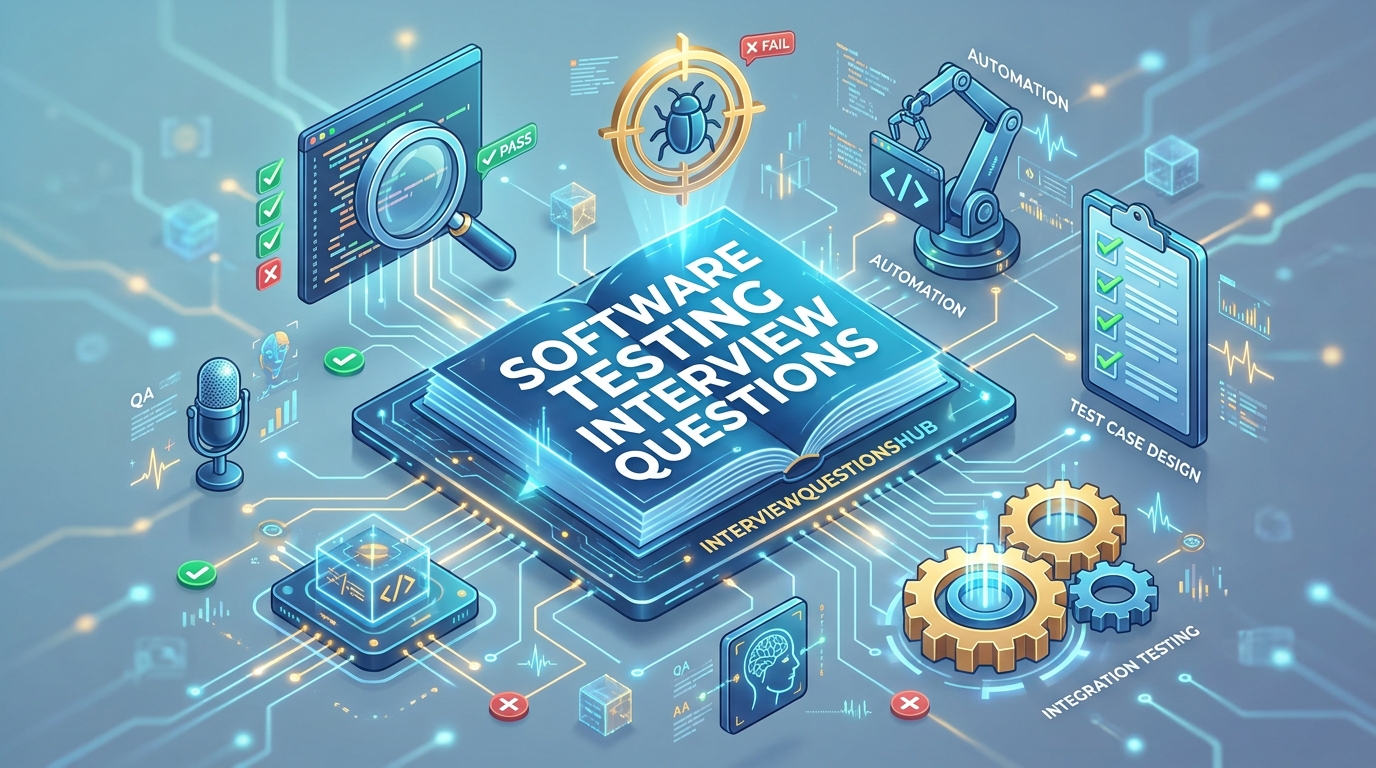
Beyond the Bug Hunt: Cracking the Software Testing Interview
Imagine a major banking app going live, only for the “Transfer Funds” button to fail on every iPhone 15. That’s the kind of nightmare scenario that keeps Quality Assurance (QA) leads up at night. In the tech world, developers build the ship, but testers make sure it actually floats in a hurricane. Whether you’re a fresher trying to grasp the difference between severity and priority or an experienced pro moving into an SDET role, the interview is your chance to prove you have the “tester’s mindset.” It’s not just about finding errors; it’s about understanding the user and protecting the business.
This guide is designed for job seekers who want to speak the language of quality. We’ve gathered the most impactful software testing interview questions and answers that reflect today’s Agile and DevOps reality. You’ll learn how to explain complex testing life cycles, handle developer pushback, and show that you can find the cracks in any software before the customer does.
Quick Answer
To excel in a software testing interview, you must demonstrate a deep understanding of the Software Testing Life Cycle (STLC), defect management, and various testing levels (Unit, Integration, System, and Acceptance). Success hinges on your ability to write clear test cases, prioritize bugs based on business impact, and adapt to both manual and automated environments.
Top 5 Software Testing Interview Questions
- What is the difference between Verification and Validation?
- How do you prioritize test cases when there isn’t enough time for full execution?
- Can you explain the various stages of the Bug Life Cycle?
- What is the difference between Severity and Priority with a real example?
- What is Regression Testing, and when is it absolutely necessary?
QUICK OVERVIEW TABLE
| Topic | No. of Questions | Difficulty Level | Best For |
| Testing Fundamentals | 5 | 🟢 Beginner | Freshers |
| Defect Management | 5 | 🟡 Intermediate | All Levels |
| Agile & Automation | 5 | 🟡 Intermediate | Mid-Senior |
| Real-world Scenarios | 5 | 🔴 Advanced | Experienced |
MAIN Q&A SECTION
1. What is the fundamental difference between Verification and Validation?
🟢 Beginner
Here’s the thing: people mix these up all the time, but they’re very different layers of quality. Verification is about checking the process—are we building the product right? It involves reviews, walkthroughs, and inspections of documents like requirements and design. Validation is about the final product—are we building the right product? It’s the actual execution of the software to ensure it meets the customer’s actual needs. In my experience, you can’t have one without the other. If you skip verification, you might build a perfect piece of software that the client didn’t actually ask for.
2. Can you explain the Software Testing Life Cycle (STLC)?
🟢 Beginner
The STLC is a sequence of specific activities conducted during the testing process to ensure software quality. It starts with Requirement Analysis—where you figure out what to test—followed by Test Planning, Test Case Development, Environment Setup, Test Execution, and finally, Test Cycle Closure. A lot of candidates miss the first step. They want to jump straight into execution. But honestly, if you don’t spend time analyzing the requirements, you’ll end up testing the wrong things. In a real project, these phases often overlap, but the logic remains the same: plan before you play.
3. What is the difference between Severity and Priority?
🟡 Intermediate
I always tell my junior colleagues: Severity is technical, Priority is business. Severity describes how much a bug impacts the system’s functionality. For example, if the app crashes when you click “Save,” that’s High Severity. Priority describes how quickly the bug needs to be fixed. Imagine the company logo on the homepage is misspelled. It’s Low Severity because the app works fine, but it’s High Priority because it looks terrible for the brand. A lot of candidates miss this distinction, but in a real project, it’s how we decide what to fix first.
4. How do you handle a bug that a developer says is “Not Reproducible”?
🟡 Intermediate
In my experience, this is where your communication skills really matter. If a developer rejects a bug, don’t get defensive. First, re-read your own steps and try to reproduce it on a different machine or browser. If it still happens, record a video of the bug occurring or provide the specific system logs. Sometimes, it’s just a configuration difference between your environment and the developer’s. Honestly, walking over to their desk (or hopping on a screen share) and showing them the issue live is often the fastest way to get it fixed.
5. What is Regression Testing and why is it important?
🟡 Intermediate
Regression testing is the practice of re-running old tests to make sure new changes didn’t accidentally break existing features. Every time a developer adds a new feature or fixes a bug, there’s a risk they’ll accidentally snap something that was working perfectly before. I’ve seen small CSS changes break an entire checkout flow. It’s absolutely vital because it protects the core functionality of the app. Without solid regression testing, you’re just moving one step forward and two steps back.
6. Can you explain the difference between White Box and Black Box testing?
🟢 Beginner
Think of Black Box testing as testing from the outside in—you don’t know the internal code; you just check if the inputs give the right outputs based on requirements. White Box testing is testing from the inside out; you actually look at the code, loops, and logic to ensure the internal paths are working correctly. In my experience, most manual testers live in the Black Box world, while developers and SDETs handle White Box via unit tests. You need both to ensure the “engine” works and the “car” drives well.
7. What is “Boundary Value Analysis”?
🟢 Beginner
Boundary Value Analysis is a test design technique based on the fact that most bugs hide at the “edges” of input ranges. If a text field accepts ages from 18 to 60, BVA says you should test 17, 18, 19 and 59, 60, 61. Honestly, developers often make mistakes with < versus <= in their code. By testing the boundaries, you’re much more likely to catch these specific logic errors than if you just tested a random number like 30. It’s a simple but incredibly powerful way to find defects.
8. What is the difference between Smoke and Sanity testing?
🟡 Intermediate
Honestly, this one trips people up because the terms are used interchangeably in many offices. Smoke testing is wide and shallow; you test the most critical features to see if the build is stable enough to start deeper testing. “Can we even log in?” is a smoke test. Sanity testing is narrow and deep; it happens after a bug fix to ensure that specific fix works and hasn’t broken the immediate logic around it. In my experience, smoke testing tells you if the “house” is standing, while sanity testing checks if the “new sink” you installed actually drains water.
9. How do you decide when to stop testing?
🔴 Advanced
Truthfully, you can never prove a piece of software is 100% bug-free. You stop testing based on “Exit Criteria” defined in the Test Plan. This usually includes: all test cases executed, all critical bugs fixed and closed, the bug discovery rate dropping, or reaching the project deadline. In my experience, it’s often a risk-based decision. If the remaining bugs are minor and the business needs to launch, you might stop. Showing you understand the balance between “perfect quality” and “business deadlines” is what interviewers really look for in senior candidates.
10. What is an Exploratory Test?
🟡 Intermediate
Exploratory testing is informal and unscripted. Instead of following a rigid test case, you use your intuition, experience, and knowledge of the system to wander through the app and find bugs on the fly. It’s best used when you’re new to a project or when time is tight. Here’s the thing: it’s not just “random clicking.” You’re actively learning the system and designing tests while you execute them. In my experience, this is often where the most “creative” bugs are found—the ones that formal test cases never expected a user to try.
11. What is the difference between a Test Plan and a Test Strategy?
🔴 Advanced
A Test Strategy is a high-level, static document that defines the overall approach to testing for an entire organization or a long-term project. It covers things like which tools to use and who is responsible for what. A Test Plan is a dynamic document for a specific release or sprint that defines what to test, the schedule, and the specific resources. Think of the Strategy as the “Constitutional Law” and the Plan as the “Current Project Schedule.” A lot of candidates mix these up, but for experienced roles, knowing the difference is key.
12. Can you explain the “Test Pyramid”?
🔴 Advanced
The Test Pyramid is a guide for how many tests you should have at different levels. At the bottom, you have a massive amount of Unit Tests (fast and cheap). In the middle are Integration Tests. At the top are UI/E2E tests (slow and expensive). A lot of teams make the mistake of having an “Ice Cream Cone”—too many UI tests and not enough unit tests. In my experience, the pyramid is the secret to a fast CI/CD pipeline. If you rely only on UI tests, your testing will be slow, flaky, and expensive to maintain.
13. What is the difference between a Bug, a Defect, an Error, and a Failure?
🟢 Beginner
In my experience, using the right terminology shows you’re a pro. An Error is a human mistake in the code. A Defect (or Bug) is the result of that error found by a tester. A Failure is when the end-user sees the system not working as expected. Basically, an Error leads to a Defect, which leads to a Failure. Honestly, this trips people up, but the key is the stage of the lifecycle. If you find it, it’s a bug; if the customer finds it, it’s a failure.
14. How do you handle testing in an Agile environment?
🟡 Intermediate
In Agile, testing isn’t a “phase” at the end; it’s a continuous activity. You work closely with developers and Product Owners from day one. You’re involved in “Amigos” meetings to clarify requirements before code is even written. This is actually really important: you’re shifting testing to the “left.” In my experience, the biggest challenge is keeping up with the speed. You have to be comfortable with “In-Sprint Automation” and accept that the requirements might change halfway through the week. It requires a lot of flexibility and communication.
15. What is the role of an Impact Analysis?
🔴 Advanced
Impact Analysis is what you do when a requirement changes or a bug is fixed in a complex system. You’re asking, “What else could this touch?” Before you start testing, you analyze the code dependencies and historical data to see which areas of the system are most likely to be affected. Honestly, this is how you decide your regression suite. Without impact analysis, you’re just guessing. A senior tester uses this to be efficient—testing the right 20% of the app that covers 80% of the risk.
COMPARISON TABLE
Testing types can be confusing, so let’s break down the core differences between two major categories.
| Feature | Manual Testing | Automation Testing |
| Execution | Human-led, step-by-step | Script-led using tools (Selenium, etc.) |
| User Experience | Great for UI/UX and feel | Can’t judge “look and feel” |
| Exploratory Work | High flexibility to wander | Limited to what’s scripted |
| Cost (Short Term) | Low; just need a tester | High; need tools and scripts |
| Reliability | Prone to human error/fatigue | Highly reliable for repetitive tasks |
INTERVIEW TIPS SECTION
- Be a “User Advocate”: Don’t just talk about code. Talk about how a bug would frustrate a customer. Interviewers love testers who care about the end-user experience.
- Acknowledge your mistakes: If you’re asked about a bug you missed in production, be honest. Explain what happened and, more importantly, how you improved your process to ensure it never happened again.
- Show off your “Soft Skills”: Testing is 50% technical and 50% communication. Talk about how you work with developers to solve problems rather than just pointing fingers.
- Practice your “Bug Stories”: Have two or three examples of complex bugs you found. Explain how you found them and why they were important for the business.
- Master the “STAR” Method: For behavioral questions, describe the Situation, Task, Action you took, and the Result. It keeps your answers organized and punchy.
WHAT INTERVIEWERS REALLY LOOK FOR
When I’m interviewing for software testing roles, I’m looking for Analytical Curiosity. I want the person who asks “Why?” and “What if?” A good tester doesn’t just check if a button works; they check if it works while the internet is slow, while the battery is low, or while the user is clicking it ten times in a row. We look for Patience. Manual testing can be repetitive, and we need to know you won’t cut corners on the 50th regression cycle.
Another big factor is Communication. You are often the bearer of bad news for developers. Can you deliver that news without causing a fight? Finally, we look for Risk Awareness. You can’t test everything. Can you prioritize the most important parts of the app that represent the biggest risk to the business? If you can show you’re a deep thinker who cares about the “Small Details,” you’re exactly the kind of person we want on our team.
FAQ : Software Testing Interview Questions
Python and Java are the industry leaders. Python is great for quick scripts and AI-driven testing, while Java is the standard for large enterprise Selenium frameworks.
For Manual QA, no. But in 2026, most roles are moving toward “Hybrid” or SDET. Knowing basic SQL and scripting will give you a massive advantage.
A Test Scenario is high-level (e.g., “Check Login functionality”). A Test Case is the detailed steps and expected results (e.g., “Step 1: Enter ‘Admin’, Step 2: Enter ‘123’…”).
Static testing (like code reviews) finds bugs without even running the software. It’s the cheapest and fastest way to find errors early in the lifecycle.
It’s the number of defects found in a software module divided by the size of that module. It helps identify which parts of the app are the “buggiest.”
Absolutely. Many testers start by learning SQL, then basic scripting, and eventually move into building full automation frameworks.
CONCLUSION
Software testing is the foundation of digital trust. Preparing for software testing interview questions is about proving you have the discipline, the eye for detail, and the communication skills to help a team succeed. Don’t just memorize definitions—understand the logic behind why we test. When you show an interviewer that you think like a user and act like an engineer, you’re not just a candidate; you’re the solution to their quality problems.
Ready to take your QA career to the next level? Check out our other expert guides:
- [How to Transition from Manual to Automation Testing]
- [Top 25 SQL Queries for QA Interviews]
- [Mastering the Agile Testing Mindset]
The bugs are out there—now go find them. Good luck with your interview!