Decoding the “Tell Me About a Time” Mystery
You’ve just nailed the technical portion of the interview. Your code was clean, your logic was sound, and you’re feeling great. Then, the interviewer leans back and asks, “Tell me about a time you had a conflict with a coworker.” Suddenly, your palms are sweaty. It’s a common pain point; how do you talk about a negative situation without sounding like a “difficult” employee? Whether you’re a fresher trying to draw on college projects or an experienced manager navigating high-stakes team dynamics, behavioral questions are the “make or break” moments of any hiring process.
This guide is for those who want to sound authentic, not scripted. You’ll learn how to transform your past experiences into compelling stories that prove you have the emotional intelligence and problem-solving skills the company needs. We’re going to move past the generic advice and look at what actually happens behind the closed doors of the interview room.
Quick Answer
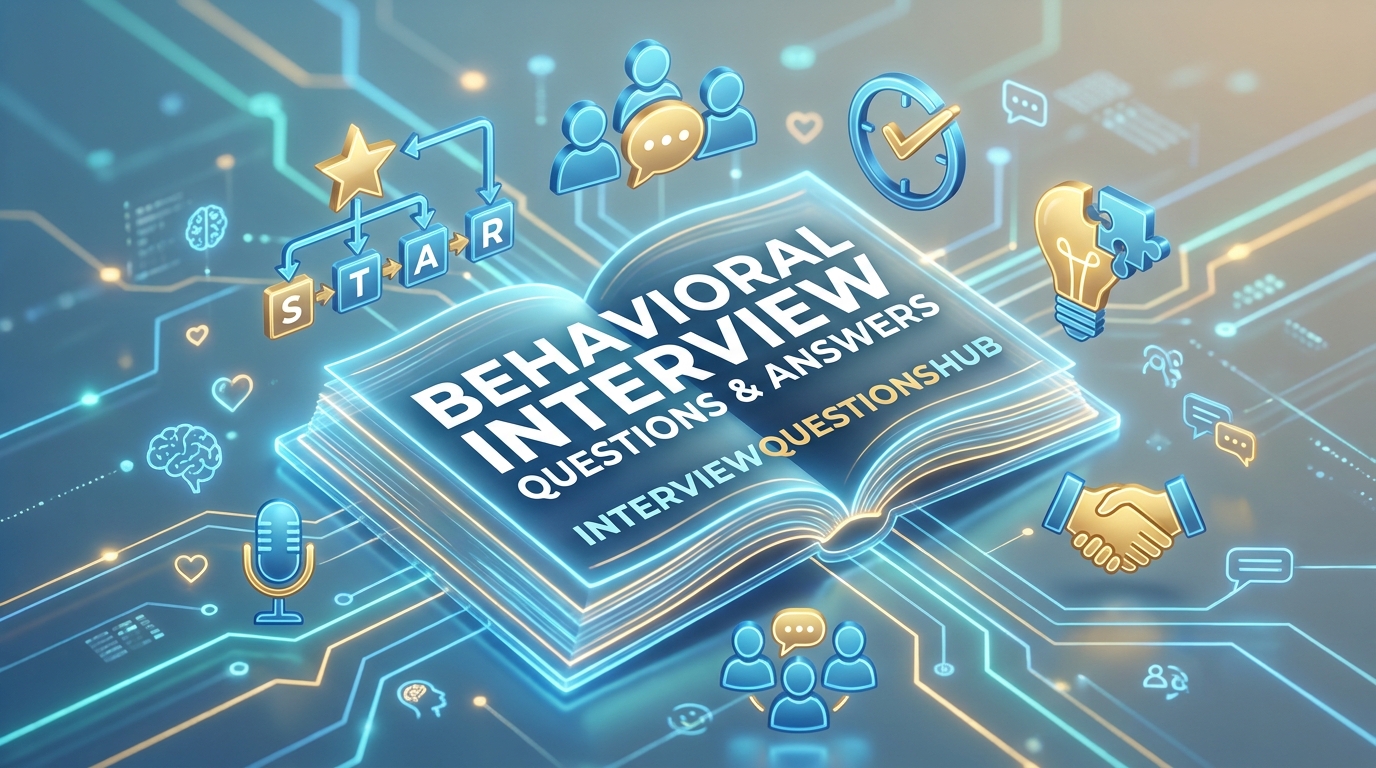
To ace behavioral interview questions, use the STAR method (Situation, Task, Action, Result) to structure your stories. Focus on demonstrating soft skills like conflict resolution, leadership, and adaptability, ensuring every answer ends with a positive, data-backed result for the company.
Top 5 Behavioral Interview Questions
- Tell me about a time you handled a difficult situation.
- Give an example of a goal you reached and how you achieved it.
- Describe a time you had a conflict with a teammate.
- Tell me about a time you made a mistake.
- Describe a situation where you had to work under a tight deadline.
QUICK OVERVIEW TABLE
| Topic | No. of Questions | Difficulty Level | Best For |
| Conflict & Teamwork | 5 | 🟡 Intermediate | All Candidates |
| Adaptability & Stress | 5 | 🟢 Beginner | Freshers |
| Leadership & Initiative | 5 | 🔴 Advanced | Experienced Pros |
| Failure & Resilience | 5 | 🟡 Intermediate | Mid-Level |
MAIN Q&A SECTION
1. Tell me about a time you had a conflict with a coworker?
🟡 Intermediate
Here’s the thing: everyone has conflicts, and if you say you’ve never had one, the interviewer won’t believe you. In my experience, they aren’t looking for who was “right”—they’re looking for your maturity. I once had a teammate who consistently missed deadlines for our marketing reports. Instead of going to the manager, I sat them down for a coffee. It turned out they were struggling with a new software tool. I spent an hour training them, and our team’s output increased by 20% the following month. Honestly, this one trips people up because they focus on the “drama” rather than the “resolution.” Always highlight the middle ground you found.
2. Describe a situation where you had to work under a tight deadline?
🟢 Beginner
This is actually really important for freshers. Interviewers want to see if you can prioritize when the pressure is on. During my final year of university, I had three major projects due in the same week. I didn’t panic; I created a prioritized “Sprint” list using Trello. I broke each project into 2-hour chunks and tackled the hardest ones first. I finished everything two days early and even had time to proofread a friend’s work. A lot of candidates miss this, but the key is to mention the specific tool or method you used to stay organized. It makes the story feel real.
3. Tell me about a time you made a mistake?
🟡 Intermediate
Honestly, this is my favorite question because it shows true character. I once accidentally sent an unfinished email draft to a high-value client. It looked unprofessional, and I was mortified. Instead of hiding it, I immediately called the client, apologized, and sent the corrected version within five minutes. The client actually appreciated the honesty and we closed the deal. In my experience, the “Action” phase here should be about Accountability. Take 100% of the blame, show how you fixed it, and explain the system you put in place (like a 10-second “unsend” timer) to ensure it never happens again.
4. Give an example of a time you showed initiative?
🔴 Advanced
Initiative is about seeing a gap and filling it without being told. At my last firm, our customer onboarding process was taking nearly ten days. Nobody asked me to fix it, but I noticed our support tickets were piling up. I spent my weekends mapping out a new automated email sequence. After I presented it to the VP, we implemented it and slashed onboarding time to just three days. This is a classic “Senior” answer because it links your personal effort directly to a business win. Use numbers whenever you can—it gives your story “teeth.”
5. Describe a time you had to adapt to a major change?
🟢 Beginner
Change is the only constant in tech and business. I remember when our company switched from Waterfall to Agile overnight. Half the team was complaining about the extra meetings. I decided to embrace it. I took an online course on Scrum basics and shared my notes with the team. I helped everyone transition their tasks to the new board. Honestly, a lot of candidates miss this: the interviewer is looking for “Resilience.” They want to know you won’t be the person dragging their feet when the company pivots to a new strategy or tool.
6. Tell me about a time you had to give difficult feedback?
🔴 Advanced
Feedback is a gift, but it’s hard to wrap. I once had a direct report who was technically brilliant but very blunt in client meetings. It was hurting our relationships. I didn’t sugarcoat it, but I used the “SBI” model (Situation, Behavior, Impact). I told them, “In yesterday’s meeting, when you interrupted the client, it made them hesitant to share their concerns.” We worked on active listening together. In my experience, showing that you can have these “brave conversations” is what separates a senior pro from a junior one. It’s about the health of the team.
7. Describe a time you went above and beyond for a customer?
🟡 Intermediate
This isn’t just for customer service roles. It applies to internal stakeholders too. A client once needed a data migration done by Monday morning, but the request came in Friday at 5 PM. It wasn’t my “job” to work the weekend, but I knew that migration was critical for their launch. I stayed, finished it by Saturday, and sent a personalized video explaining the new setup. The client became our biggest advocate. This is actually really important: you’re demonstrating Ownership. You care about the outcome, not just the clock-in and clock-out times.
8. Tell me about a time you disagreed with your manager?
🔴 Advanced
This is a high-wire act. You want to show you have a backbone, but you aren’t a rebel. I once disagreed with my manager’s decision to cut our QA budget. I didn’t just argue; I gathered data on how many bugs we’d caught in the last quarter and the potential cost of those reaching production. I presented it as a “Risk Mitigation” plan. We ended up keeping 80% of the budget. In my experience, the best way to handle this is to show that your disagreement was based on facts and logic, not ego. You were looking out for the company’s best interest.
9. Give an example of how you handled a teammate not pulling their weight?
🟡 Intermediate
This trips people up because they don’t want to sound like a “snitch.” Don’t blame the person. Instead, talk about how you focused on the goal. I once had a group project where one member stopped responding to emails. I reached out privately to see if they were okay. It turned out they were overwhelmed by a personal issue. I helped them reallocate their smaller tasks and kept the manager informed of the timeline shift without throwing the person under the bus. It shows you’re a team player who prioritizes the project’s success over being right.
10. Describe a time you had to learn something new very quickly?
🟢 Beginner
Freshers, this is your time to shine. I was hired for a role that suddenly required me to use Salesforce, which I had never touched. I didn’t wait for training. I spent every evening that first week on “Trailhead” and YouTube. By Friday, I was the one showing the other new hires how to log their leads. Honestly, this one is about Resourcefulness. You don’t need to know everything, but you need to show you have the “learning muscle” to pick up any tool they throw at you in 2026.
COMPARISON TABLE: INTERVIEW STRATEGIES
Choosing the right way to frame your answer is just as important as the story itself.
| Strategy | Best For | Focus | Result |
| STAR Method | Complex Stories | Situation, Task, Action, Result | Provides a logical, easy-to-follow flow. |
| CAR Method | Quick Achievements | Challenge, Action, Result | Punchy and great for result-oriented roles. |
| SBI Model | Feedback/Conflict | Situation, Behavior, Impact | Shows professional maturity and empathy. |
INTERVIEW TIPS SECTION
- The Power of the Positive: Even if the question is about a failure or a conflict, always end on a high note. Talk about what you learned or the positive outcome that followed the struggle.
- Keep it Recent: Try to use examples from the last 12–18 months. Stories from ten years ago make it look like you haven’t grown much lately, unless it’s a truly “heroic” story.
- Quantify Your Results: Don’t just say “we did better.” Say “we increased efficiency by 15%” or “we saved $2,000 in monthly overhead.” Data makes your stories “sticky” in the interviewer’s mind.
- Practice Out Loud: Behavioral answers can wander if you aren’t careful. Record yourself and aim for the 90-second mark. If you go longer, you risk losing the interviewer’s attention.
- Vary Your Stories: Don’t use the same project for every single answer. You want to show a “360-degree” view of your skills, from technical problem-solving to emotional intelligence.
WHAT INTERVIEWERS REALLY LOOK FOR
When we ask behavioral questions, we’re doing a “future performance” check. The logic is simple: how you acted in the past is the best predictor of how you’ll act in the future. We’re looking for Self-Awareness. Can you admit you made a mistake? Do you understand how your actions affected the rest of the team?
We also look for Cultural Alignment. Every company has a “vibe.” If a company values “Radical Candor,” they want to hear that you speak your mind even when it’s uncomfortable. If they value “Harmony,” they want to hear how you smoothed things over. Lastly, we look for Action-Orientation. We don’t want people who just observe problems; we want the people who grab a shovel and start digging. If your stories show you as the “Catalyst” for change, you’re getting the offer.
FAQ : Behavioral Interview Questions
Don’t lie. Say, “I haven’t faced that exact situation yet, but if I did, here is the logical process I would follow to handle it.”
Try to keep it professional. However, if you’re a fresher, using examples from volunteer work, sports teams, or club leadership is perfectly fine.
Aim for 5–7 versatile stories. You can often tweak one story to answer multiple questions (e.g., a “conflict” story can also be an “adaptability” story).
Yes! Bringing a “cheat sheet” of your STAR bullet points shows you’re prepared and serious about the role. Just don’t read from it like a script.
Talking too much about “We” and not enough about “I.” The interviewer wants to hire you, not your whole team, so be specific about your actions.
Absolutely. In 2026, even the best coders need to work in squads. Your ability to collaborate is just as important as your ability to write code.
CONCLUSION
Behavioral interview questions are your chance to show the “human” behind the resume. They aren’t traps; they’re opportunities to prove that you’re someone people actually want to work with for 40 hours a week. Don’t worry about being perfect. In fact, stories of failure and recovery are often much more impressive than stories of easy wins. Prepare your STAR stories, focus on your growth, and remember that your past is simply the foundation for the value you’re about to bring to this new role.
Ready to level up your career? Check out our other expert guides:
- [The Ultimate Guide to the STAR Method]
- [Top 30 Common Interview Questions and Answers]
- [How to Handle Salary Negotiation Like a Pro]
You’ve got the experience—now go tell the story. Good luck!