The Ranking Game: Cracking the Search Engine Interview
Imagine you’ve been managing a niche blog for a year, and you finally land an interview with a top-tier digital agency. You’re confident until the lead strategist asks, “How would you optimize our site for Google’s latest AI Overviews without losing traditional organic traffic?” Your heart sinks. In the world of search, the goalposts move every time Google pushes a core update. Whether you’re a fresher trying to explain the basics of a meta tag or an experienced pro discussing crawl budgets and E-E-A-T, the interview is where you prove you can stay ahead of the algorithm.
This guide is designed for job seekers who want to sound like experts, not robots. We’ve compiled the most critical SEO interview questions and answers that reflect the reality of search in 2026. You’ll learn how to break down complex technical audits, justify your link-building spend, and demonstrate the kind of strategic thinking that turns a “candidate” into a “colleague.”
Quick Answer
To ace an SEO interview, you must demonstrate a balanced mastery of technical SEO, content strategy, and data analysis. Focus on showing how you drive actual business revenue—not just traffic—through keyword intent mapping, high-quality backlink acquisition, and optimizing for user experience signals.
Top 5 SEO Interview Questions
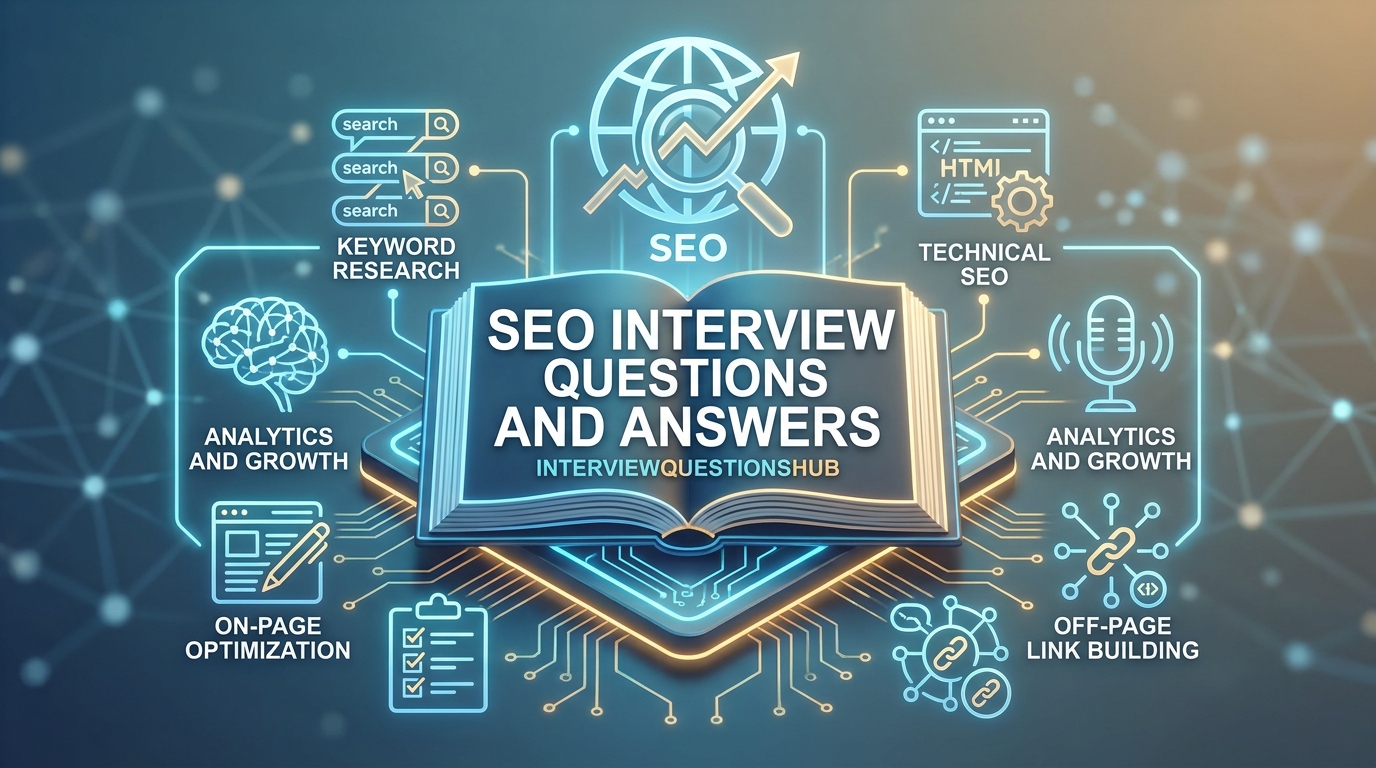
- What is the difference between On-Page, Off-Page, and Technical SEO?
- How does Google’s Search Generative Experience (SGE) impact organic CTR?
- Can you explain the importance of Core Web Vitals for rankings?
- How do you conduct keyword research for a completely new niche?
- What would you do if a website’s traffic suddenly dropped by 50%?
QUICK OVERVIEW TABLE
| Topic | No. of Questions | Difficulty Level | Best For |
| On-Page & Content | 5 | 🟢 Beginner | Freshers |
| Technical SEO | 5 | 🟡 Intermediate | 2+ Years Exp |
| Off-Page & Strategy | 5 | 🔴 Advanced | Senior Strategists |
| AI & Future Trends | 5 | 🟡 Intermediate | All Levels |
MAIN Q&A SECTION
1. What exactly is SEO and why is it still relevant?
🟢 Beginner
In my experience, a lot of people think SEO is just about “tricking” Google. Here’s the thing: SEO is actually about being the best answer to a user’s question. It’s the practice of optimizing a website to increase its visibility in organic search results. It’s still relevant because search is how people discover everything from heart surgeons to hiking boots. Even with AI chat, people still need to visit websites to buy products or verify facts. If you aren’t visible in that journey, you’re effectively invisible to your customers.
2. What is the difference between Crawling and Indexing?
🟢 Beginner
Honestly, this one trips people up a lot. Think of the web like a giant library. Crawling is Google’s bots (spiders) following links to discover new “books” or pages. Indexing is when Google decides to actually put that book on its library shelves. Just because a page is crawled doesn’t mean it will be indexed. If the content is thin or duplicate, Google might crawl it and then say, “No thanks,” and leave it out of the index. You can check this in Google Search Console’s “Pages” report—it’s a goldmine for fixing these issues.
3. Can you explain what E-E-A-T stands for?
🟡 Intermediate
E-E-A-T stands for Experience, Expertise, Authoritativeness, and Trustworthiness. This is actually really important in the age of AI. Google wants to know: Does the author have actual Experience with the topic? Are they an Expert? Is the website an Authority? And most importantly, is the information Trustworthy? For example, a medical article written by a certified doctor on a hospital’s website has high E-E-A-T. A random blog post about medicine written by an anonymous AI doesn’t. Trust is the core—if users can’t trust the info, Google won’t rank it.
4. How do you handle a “Manual Action” or a Google Penalty?
🔴 Advanced
A manual action is like getting a red card from a referee—it means a human reviewer at Google found that your site violated their guidelines. First, you have to go to Search Console to see the exact reason. In my experience, it’s usually for “unnatural links” or “thin content.” You have to fix the issue, document every step you took (like disavowing bad links or rewriting content), and then submit a “Reconsideration Request.” It’s a slow, stressful process, so the best strategy is always to stay within the lines from the start.
5. What are Core Web Vitals (CWV)?
🟡 Intermediate
Core Web Vitals are a set of specific factors that Google considers important in a webpage’s overall user experience. They focus on three things: loading speed (LCP), interactivity (FID or INP), and visual stability (CLS). Think of it this way: if a page takes forever to load, or the buttons move around while you’re trying to click them, users will get frustrated and leave. Google tracks these signals because a happy user is more likely to come back to Google. This is a technical area, but it’s really about basic human patience.
6. What is “Keyword Intent” and why does it matter?
🟢 Beginner
Keyword intent is the why behind a search query. Are they looking to buy something (Transactional), find a specific site (Navigational), or just learn something (Informational)? A lot of candidates miss this: if you target “best running shoes” (Informational/Comparison) with a product page (Transactional), you won’t rank. Google knows the user wants a listicle, not a checkout button. You have to match your content type to what the user is actually looking for. It sounds simple, but it’s the foundation of modern SEO strategy.
7. How do you optimize for “Featured Snippets”?
🟡 Intermediate
Featured Snippets are the “Position Zero” results that appear at the top of the page. To win these, you need to provide a clear, concise answer to a specific question early in your content. I usually recommend using a “Quick Answer” box or a bulleted list. For example, if your target keyword is “how to bake bread,” have a section titled exactly that with the steps clearly numbered. Google loves structured data and direct answers. Honestly, the secret is looking at what’s currently in the snippet and making your version 10% clearer.
8. What is a “Crawl Budget” and should I worry about it?
🔴 Advanced
Crawl budget is the number of pages Googlebot will crawl on your site in a given timeframe. If you have a small site with 50 pages, don’t sweat it. But for massive e-commerce sites with millions of URLs, it’s a big deal. If Google wastes its “budget” on broken pages, thin filters, or duplicate parameters, it might never find your high-value product pages. You optimize this by using robots.txt to block useless sections and ensuring your internal linking is clean. It’s about making Google’s job as easy as possible.
9. How do you use “Canonical Tags” correctly?
🟡 Intermediate
Canonical tags are your way of telling Google: “Hey, I know these three pages look similar, but this one is the original version.” This is huge for e-commerce sites where a single product might have different URLs for different colors or sizes. Without a canonical tag, Google sees “Duplicate Content” and gets confused about which one to rank. By setting a rel="canonical", you consolidate your “ranking power” into one URL. A lot of people forget that a page should usually have a self-referencing canonical tag too—it’s just good practice.
10. What is the difference between a 301 and a 302 redirect?
🟢 Beginner
A 301 redirect is a “permanent” move. It tells Google that the old page is gone forever and that all its “SEO juice” (authority) should move to the new URL. A 302 is a “temporary” move. You use it if you’re just testing a page or doing maintenance. In my experience, the biggest mistake is using a 302 when you actually mean 301. If you use a 302 for a permanent move, Google won’t pass the authority to the new page, and your rankings will eventually suffer. Use 301s for site migrations every single time.
11. How do you approach Link Building in 2026?
🔴 Advanced
Link building isn’t about quantity anymore; it’s about “Relevance” and “Authority.” Buying 100 cheap links from a Fiverr gig will get you penalized faster than you can hit refresh. Instead, I focus on “Digital PR”—creating something so useful (like a data study or a unique tool) that other sites want to link to it naturally. I also look for guest posting opportunities on sites that actually have real traffic. If no humans visit the site linking to you, Google probably doesn’t value that link much either.
12. What is “Schema Markup” and how does it help?
🟡 Intermediate
Schema is a specialized code (JSON-LD) that you add to your site to help search engines understand your content better. It doesn’t directly “boost” your rankings, but it qualifies you for “Rich Snippets”—those cool stars, prices, or FAQ dropdowns you see in the results. These snippets make your listing stand out, which increases your Click-Through Rate (CTR). In my experience, adding FAQ schema to a service page is one of the fastest ways to grab more “real estate” on the search results page.
13. How do you conduct an SEO Audit for a new client?
🔴 Advanced
I always start with a “Technical First” approach. I’ll use a tool like Screaming Frog to find 404 errors, redirect loops, and missing tags. Then, I check Google Search Console for indexing issues. Next, I move to “On-Page”—checking if the keywords align with the intent. Finally, I look at the backlink profile to see if there’s any “toxic” baggage. A lot of candidates just run a tool and hand over the PDF. A senior pro takes that data and prioritizes it: “Fix these three things first because they’ll give us the biggest win.”
14. What is the impact of “Voice Search” on SEO?
🟡 Intermediate
Voice search is much more conversational and usually takes the form of a question. Instead of typing “weather Ahmedabad,” someone might say, “Hey Google, what’s the weather like in Ahmedabad today?” To optimize for this, you need to target long-tail keywords and “natural language” phrases. This often ties back to winning Featured Snippets, because when you ask a smart speaker a question, it usually reads back the “snippet” result. It’s about being the most direct, spoken-word answer to a user’s problem.
15. How would you prioritize SEO tasks for a developer?
🔴 Advanced
Developers are busy, so you can’t just give them a 100-page list. I use a “High Impact, Low Effort” matrix. If a site is blocked by robots.txt, that’s a 1-minute fix with 1000% impact—that goes to the top. If I want to change the image alt text on 5,000 pages, that’s high effort and lower impact. You have to speak their language. Don’t just say “make it faster”; say “we need to reduce the Largest Contentful Paint (LCP) by optimizing our hero image compression.” This builds respect and gets things done.
COMPARISON TABLE
On-Page SEO vs. Technical SEO
| Feature | On-Page SEO | Technical SEO |
| Primary Focus | Content and Keywords | Backend and Site Structure |
| Who Handles It? | Content Writers / SEOs | Developers / Technical SEOs |
| Examples | H1 tags, Keyword density, Meta descriptions | XML Sitemaps, HTTPS, Page speed |
| User Impact | Helps users understand the page content | Ensures the site is fast and accessible |
| Search Impact | Helps Google “understand” what you do | Helps Google “find” and “index” your pages |
INTERVIEW TIPS SECTION
- Show your data: Don’t just say you’re an SEO expert. Bring a screenshot of a Google Search Console graph showing growth you achieved.
- Talk about “Intent,” not just “Keywords”: Mentioning that you categorize keywords by user intent shows you understand modern search behavior.
- Be Tool-Fluent: Be ready to discuss how you use Semrush, Ahrefs, Search Console, and Screaming Frog in your daily workflow.
- Admit what you don’t know: SEO is massive. If you’re asked about a niche topic like “International Hreflang” and you haven’t done it, say so, then explain how you’d research it.
- Focus on ROI: Always link your SEO wins back to business goals. “I increased organic traffic by 20%” is good; “I increased organic leads by 20%” is much better.
WHAT INTERVIEWERS REALLY LOOK FOR
When I’m interviewing for an SEO role, I’m looking for Curiosity. Do you read the Google Search Central blog? Do you follow industry experts on X? SEO changes too fast for someone who doesn’t like to read. We also look for Analytical Thinking. If traffic drops, do you panic, or do you start segmenting data by device, country, and page type to find the cause?
Another big one is Communication. An SEO spends half their time convincing writers to change their headlines and developers to change their code. If you can’t explain “Why” a change matters in simple terms, you’ll never get anything implemented. Finally, we look for Patience. SEO takes time. We want to know that you can manage stakeholder expectations without overpromising “overnight rankings.”
FAQ : SEO Interview Questions & Answers
No. AI search engines still need sources. SEO is evolving into “Generative Engine Optimization” (GEO), focusing on being the source that AI models cite.
Generally, it takes 3 to 6 months to see significant movement. It depends on the site’s authority and the competitiveness of the keywords.
Start with long-tail keywords. They are easier to rank for and often have higher conversion rates because the user’s intent is more specific.
Not directly. Social signals (likes/shares) aren’t a ranking factor, but social media can drive traffic and help your content get discovered by people who might link to it.
It’s very beginner-friendly and has great plugins like Yoast or RankMath, but you can do great SEO on almost any platform if you have technical control.
CONCLUSION
SEO is a marathon, not a sprint, and your interview is the chance to show you have the stamina for the long haul. It’s not about knowing every single ranking factor (there are hundreds!); it’s about knowing which ones move the needle for that specific business. Use these SEO interview questions to build your confidence, but remember to stay humble—the algorithm is a tough teacher. Focus on the user, stay obsessed with the data, and you’ll find that the rankings usually take care of themselves.
Ready to level up your marketing game? Check out our other guides:
- [How to Conduct a Professional SEO Audit]
- [The Ultimate Guide to Google Search Console]
- [SEO vs. PPC: Which is Right for Your Business?]
Keep optimizing, and good luck with your interview!