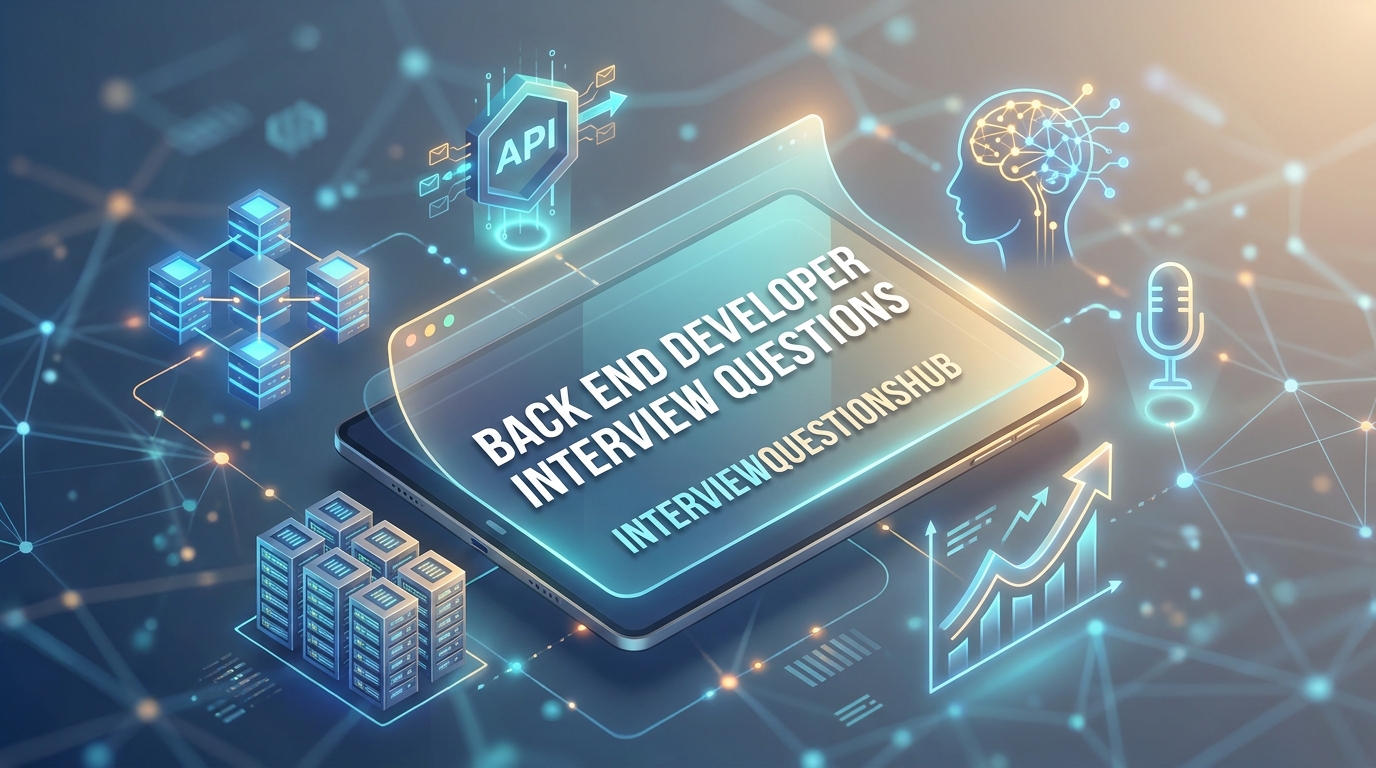
The Engine Room: Navigating the Back-End Interview
Imagine you’ve just deployed a major update, and within minutes, the database CPU spikes to 100%, and the API response time crawls to ten seconds. This is the nightmare scenario every back-end engineer fears. In an interview, companies aren’t just checking if you know how to write a function; they want to see if you can handle that pressure and build systems that don’t crumble under load. Whether you’re a fresher looking for your first “Junior” tag or a seasoned veteran scaling distributed systems, the interview process is your chance to prove you understand the invisible mechanics that power the web.
This guide is for those who live in the server logs and database schemas. You’ll learn how to tackle complex Back End Developer interview questions and answers ranging from basic API design to advanced architectural trade-offs. We’ll dive into the core concepts that separate those who just write code from those who build resilient, scalable infrastructure.
Quick Answer
To excel in a Back End Developer interview, you need to demonstrate deep knowledge of server-side logic, database management (SQL/NoSQL), and API architecture (REST/GraphQL). Success hinges on your ability to explain system scalability, security best practices, and how to write efficient, testable code that handles concurrent users effectively.
Top 5 Back End Developer Interview Questions
- What is the difference between a Monolithic and a Microservices architecture?
- How do you optimize a slow database query?
- What are the different types of HTTP status codes and what do they represent?
- How do you ensure the security of a REST API?
- What is “Horizontal Scaling” and how does it differ from “Vertical Scaling”?
QUICK OVERVIEW TABLE
| Topic | No. of Questions | Difficulty Level | Best For |
| Core Logic & APIs | 5 | 🟢 Beginner | Freshers |
| Database Management | 5 | 🟡 Intermediate | All Levels |
| System Architecture | 5 | 🔴 Advanced | Experienced |
| Security & DevOps | 5 | 🟡 Intermediate | Mid-Senior |
MAIN Q&A SECTION
1. What is the difference between REST and GraphQL?
🟡 Intermediate
Here’s the thing: REST is like a set menu at a restaurant where you get exactly what’s listed, while GraphQL is like a buffet where you pick exactly what you want. In REST, you have multiple endpoints (like /users or /posts), and you often end up “over-fetching” data you don’t need. GraphQL uses a single endpoint and lets the client specify the structure of the data it requires. Honestly, this one trips people up because they think one is “better.” In my experience, REST is great for simple, standard APIs, but GraphQL shines when you have complex data relationships and want to save mobile bandwidth.
2. How do you handle a “Race Condition” in a database?
🔴 Advanced
A race condition happens when two users try to update the same piece of data at the exact same moment. Imagine two people booking the last seat on a flight simultaneously. To solve this, you use “Locking.” You have Optimistic Locking, where you check if the data changed since you last read it (usually with a version number), and Pessimistic Locking, where you literally lock the row so no one else can touch it until you’re done. A lot of candidates miss this, but choosing the right locking strategy is crucial for keeping your data consistent without killing your app’s performance.
3. Can you explain what a “MiddleWare” is?
🟢 Beginner
Think of middleware as a series of checkpoints or filters that a request has to pass through before it reaches your main logic. It’s like airport security. One middleware might check if you’re logged in (Authentication), another might log the request details for debugging, and a third might compress the data to make it faster. It’s a way to keep your code “DRY” (Don’t Repeat Yourself). Instead of writing auth logic in every single route, you just drop in a middleware. This is actually really important for keeping a clean, modular codebase.
4. What is the difference between an Inner Join and a Left Join?
🟢 Beginner
In my experience, if you can’t visualize joins, SQL will always be a struggle. An Inner Join only returns rows where there is a match in both tables. If you join Users and Orders, you only get users who have actually bought something. A Left Join returns all users from the left table, even if they have zero orders (those missing order fields just show up as NULL). Honestly, I see people use the wrong join all the time and end up accidentally deleting data from their reports. Always ask yourself: “Do I need to see the people who haven’t done anything yet?”
5. How does a “Message Queue” like RabbitMQ or Kafka work?
🔴 Advanced
A message queue is essentially a buffer that sits between two services so they don’t have to talk to each other in real-time. Imagine a user uploads a huge video. If the server tries to process it immediately, the user’s browser will just hang. Instead, the server says, “I’ve got the file,” puts a “task” in the queue, and tells the user “We’re working on it!” A separate worker service then picks up that task when it has the capacity. This “asynchronous” processing is how big apps like Instagram or YouTube stay responsive even when they’re doing heavy lifting behind the scenes.
6. What are the ACID properties in a database?
🟡 Intermediate
ACID stands for Atomicity, Consistency, Isolation, and Durability. It’s the gold standard for database transactions. Atomicity means the “All or Nothing” rule—if one part of a bank transfer fails, the whole thing is rolled back. Consistency ensures the data follows all rules (like no negative balances). Isolation ensures that two transactions don’t mess with each other. Durability means that once a transaction is committed, it stays saved even if the power goes out. This is a favorite “Experienced” question because it proves you understand the risks of data loss in a production environment.
7. What is “Database Indexing” and how does it work?
🟡 Intermediate
Indexing is like the index at the back of a textbook. Without it, if you’re looking for a specific topic, you have to read every single page (a “Full Table Scan”). With an index, you go to the back, find the page number, and jump straight there. In a database, an index creates a separate data structure (usually a B-Tree) that stores pointers to the rows. It makes SELECT queries incredibly fast, but there’s a catch: it makes INSERT and UPDATE operations a bit slower because the database has to update the index too. Balance is key here.
8. What is the difference between JWT and Session-based authentication?
🟡 Intermediate
Session-based auth is like a coat check: the server gives you a ticket (session ID) and keeps your “coat” (user data) in its memory. Every time you come back, the server has to look up that ID in its database. JWT (JSON Web Token) is more like a digital passport. The token itself contains all your info, and it’s signed by the server so it can’t be faked. The server doesn’t need to store anything in memory; it just validates the signature. JWT is great for microservices and scaling, but be careful—once a JWT is issued, it’s hard to “revoke” it before it expires.
9. How do you design a “Idempotent” API?
🔴 Advanced
“Idempotent” sounds fancy, but it just means that making the same request multiple times has the same effect as making it once. Think of an elevator button: no matter how many times you press “5,” you still end up on the 5th floor. In APIs, a GET request is naturally idempotent. A POST request (like “Charge Credit Card”) is NOT. To make it idempotent, you can use an “Idempotency Key” (a unique ID sent by the client). If the server sees the same key twice, it knows it’s a retry and doesn’t process the payment a second time. This is a must-know for financial systems.
10. What is the purpose of a “Load Balancer”?
🟢 Beginner
A load balancer is like a traffic cop standing in front of a group of servers. When a request comes in, the load balancer decides which server is the least busy and sends the request there. This prevents any single server from getting overwhelmed. It also provides “High Availability”—if one server crashes, the load balancer just sends traffic to the others. For any app hoping to scale to thousands of users, a load balancer is the first piece of infrastructure you’ll need.
11. Explain “N+1 Query Problem” and how to fix it.
🟡 Intermediate
This one is a silent performance killer. Imagine you fetch 10 posts, and for each post, you run a separate query to get the author’s name. That’s 1 query for the posts + 10 queries for the authors = 11 queries. If you have 1000 posts, you’re hitting the database 1001 times! You fix this using “Eager Loading” or “Joins.” Instead of many small queries, you write one big query that fetches the posts and authors together. Honestly, this is the first thing I check when a dev tells me their page is loading slowly.
12. What are the 5xx series of HTTP status codes?
🟢 Beginner
While 4xx codes mean “You (the client) messed up,” 5xx codes mean “I (the server) messed up.” The most common is 500 Internal Server Error, which is the generic “something broke” message. 502 Bad Gateway usually means a proxy server couldn’t get a response from the main server, and 503 Service Unavailable often means the server is overloaded or down for maintenance. Knowing these by heart helps you debug issues much faster during a live-site incident.
13. How do you handle “CORS” errors?
🟡 Intermediate
Ah, the dreaded CORS (Cross-Origin Resource Sharing) error. It’s a security feature in browsers that prevents a website on domain-a.com from making an API request to api-b.com unless api-b.com explicitly allows it. To fix it, your back-end needs to send specific headers, like Access-Control-Allow-Origin. A lot of candidates just set it to * (allow everything), but in a professional setting, that’s a security risk. You should only whitelist the specific domains that need access.
14. What is the “Repository Pattern” in back-end development?
🟡 Intermediate
The Repository Pattern is a layer between your business logic and your database code. Instead of writing SQL queries directly inside your “Create User” function, you call userRepository.save(user). This makes your code much easier to test because you can swap out the real database repository for a “Mock” one during testing. It also means if you ever switch from MySQL to MongoDB, you only have to change the code in one place (the repository) rather than throughout your entire application.
15. What is “Connection Pooling”?
🔴 Advanced
Opening a new connection to a database is a “heavy” and slow operation. If your API opens and closes a connection for every single request, it will eventually crawl to a halt under load. A Connection Pool keeps a set of “ready-to-use” connections open in the background. When a request comes in, it “borrows” a connection, uses it, and then “returns” it to the pool. It’s like a library for database connections. Using a pool can often increase your API’s throughput by 10x with very little effort.
COMPARISON TABLE
SQL vs. NoSQL: Choosing Your Data Store
| Feature | SQL (Relational) | NoSQL (Non-Relational) |
| Data Structure | Strict Tables & Rows | Flexible (JSON, Key-Value, Graph) |
| Scaling | Vertical (Scale Up) | Horizontal (Scale Out) |
| Transactions | Strong ACID Compliance | Varies (often “Eventual Consistency”) |
| Best Use Case | Complex joins, Financial apps | Real-time feeds, Big Data, High Speed |
| Example | PostgreSQL, MySQL | MongoDB, Redis, Cassandra |
INTERVIEW TIPS SECTION
- Draw the System: If you’re asked an architecture question, don’t just talk—grab a whiteboard (or use a digital one). Visualizing how data flows between a Load Balancer, API, and Cache shows you think in systems.
- Acknowledge Trade-offs: There is no “perfect” technology. If you suggest a Microservices approach, mention that it adds complexity to deployment. Senior engineers value honesty about pros and cons.
- Master the “Explain Like I’m Five” (ELI5): If you can’t explain a complex concept like “Sharding” to a non-technical person, you probably don’t understand it well enough. Practice simplifying your answers.
- Focus on Observability: Don’t just talk about building a feature; talk about how you’d monitor it. Mentioning things like “Logging,” “Metrics,” and “Alerting” shows you’ve managed real production systems.
- Read the Logs: If you’re doing a live coding challenge and something breaks, the first thing you should do is check the console/logs. Silent debugging is an interview killer; explain what the error message is telling you.
WHAT INTERVIEWERS REALLY LOOK FOR
When we interview for back-end roles, we aren’t just looking for a “coder”—we’re looking for an Engineer. This means we care about Edge Case Thinking. When you write a function, do you ask, “What happens if the database is down?” or “What happens if the user sends an empty string?” We look for Security Consciousness. A back-end dev who doesn’t think about SQL injection or password hashing is a liability.
We also look for Scalability Mindset. You might be building a small tool now, but we want to know if you understand how to make it work for 100,000 users later. Finally, Communication is massive. Back-end devs work closely with Front-end and DevOps teams. If you can’t clearly define an API contract or explain why a certain database choice was made, the whole project slows down.
FAQ : Back End Developer Interview Questions
It depends on your goal. Node.js is huge for startups and real-time apps. Java is the king of corporate enterprise. Python is great for AI and rapid development. Pick one and get deep with it.
For 90% of roles, you just need basic logic. However, you do need to understand Big O notation (complexity) to ensure your algorithms don’t slow down as data grows.
It just means someone else’s servers. Instead of buying hardware, you rent space on AWS, Google Cloud, or Azure. Knowing the basics of these platforms is almost mandatory in 2026.
Because if your back-end fails, the whole app dies. Unit tests and Integration tests act as a safety net, ensuring that a small change doesn’t break a critical feature like “Login” or “Payment.”
Yes! While a little “Front-end empathy” helps, most professional back-end devs never touch CSS. Your focus should be on data, logic, and infrastructure.
CONCLUSION
Cracking the back-end interview is about proving you can build the foundation that a business can trust. It’s one thing to make a feature work; it’s another to make it fast, secure, and easy to maintain. Focus on the “Core” skills—Databases, APIs, and Architecture—and the rest will follow. Remember, every senior dev you admire has spent hours debugging the same 500 errors you’re facing now. Keep building, keep breaking things, and keep learning.
Check out our other guides to stay ahead:
- [The Ultimate Guide to Database Sharding]
- [Building Secure APIs: A Checklist for 2026]
- [Microservices vs Monolith: The Real Truth]
The server is waiting. Good luck!